Saturday, December 10, 2005

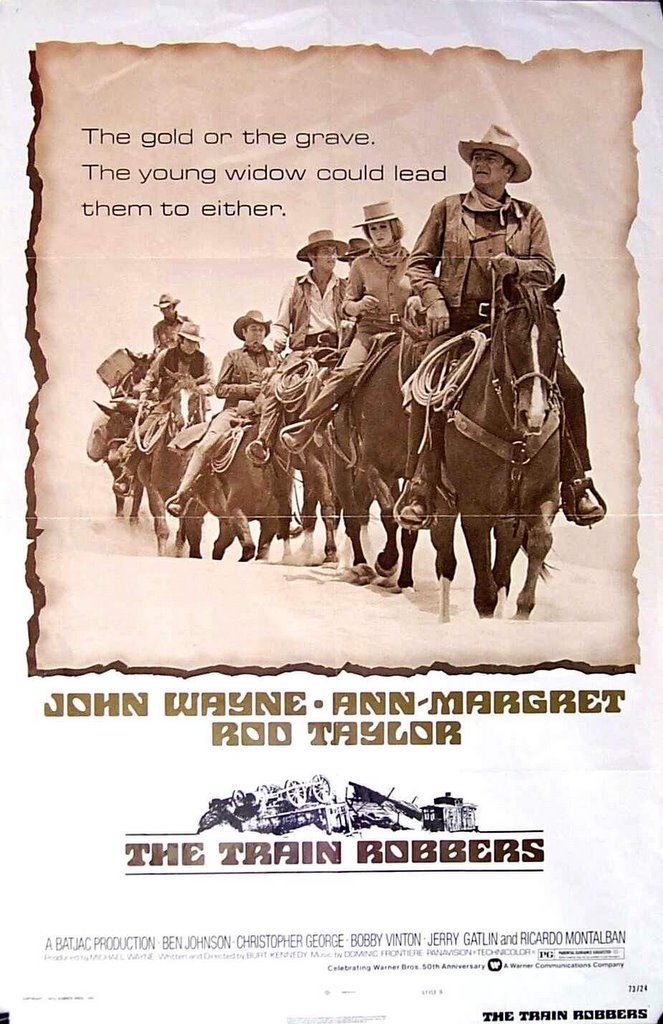
Republican Values: Train Robbery by Crooks for Cronies


The New York Times
December 11, 2005
Lawmaker Adds More Vegetables to Amtrak Load
By MATTHEW L. WALD
and GLEN JUSTICE

WASHINGTON, Dec. 10 - Amtrak certainly knows how to lose money, but the railroad says it can lose less if only it can get out of the business of hauling cars of "premium" freight like perishables behind its cross-country trains.

Instead, Congress has told Amtrak to increase sharply the number of carloads it hauls or forgo $8.3 million in additional federal money.

The order, contained in the transportation bill signed by President Bush last month, was inserted late in the process by Representative Joe Knollenberg, an appropriations subcommittee chairman from Michigan. The Detroit businessman who owns the only company that supplies such rail cars happens to be a large donor to Mr. Knollenberg, a Republican, and other Michigan lawmakers.

Mr. Knollenberg acknowledged that the order, known in Washington as an earmark, was likely to help the businessman, Anthony Soave, and his company, ExpressTrak. But he said the main goal was to help Amtrak make money by hauling freight.

Until Friday, he aggressively defended the provision.

"If you do it right, you are not just throwing money at the wall," he said in an interview on Wednesday. "It gives this idea some push to make it produce some profit. I think there is some possibility of this succeeding."

But Mr. Knollenberg changed course Friday afternoon. After documents obtained by The New York Times raised questions about lobbying by ExpressTrak and its lawyers to obtain the $8.3 million for Amtrak, Mr. Knollenberg released a statement saying he would work to reverse the legislation.

"I have decided to repeal the provision and rescind the funds in question," he said.

For now, however, the provision remains in place. Critics blasted it this week as exactly the type of behavior that has left Amtrak famously dependent on federal handouts. Congress established the railroad in 1971 as a private, for-profit corporation and has intermittently promised company managers a free hand to run it like a business. But lawmakers continue to exercise influence because Amtrak must curry political favor to maintain its subsidy.

"You can't have this type of micromanagement when they're trying to get Amtrak to run itself more like a business," said Thomas A. Schatz, president of Citizens Against Government Waste, which tracks federal spending, referring to the $8.3 million.

There are also other problems. ExpressTrak, which is in bankruptcy, and Amtrak, which will get about $1.3 billion from Congress to keep it out of bankruptcy, have been jousting in court for years over a 15-year contract they signed in 1999 requiring the railroad to haul premium freight like fruits and vegetables. Amtrak says ExpressTrak defaulted on lease payments for cars the railroad provided, which ExpressTrak denies.

ExpressTrak now has only 56 cars for premium freight. Amtrak repossessed 55 others in the lease payment dispute, and they are now sitting on a siding in Pennsylvania. It would take years for ExpressTrak to complete the number of shipments Congress wants with the cars it still has.

ExpressTrak's lawyers say the federal financing enables the two companies to continue a venture that advocates say can one day be profitable, but Amtrak says it has not decided whether to take the money and increase the shipments.

The $8.3 million is notable for another reason: it is almost precisely the amount that ExpressTrak's lawyers seem to have identified as a minimum target figure it wanted from Amtrak for settling the company's lawsuit against Amtrak, records show. A 2003 agreement between ExpressTrak and the law firm Foley & Lardner, which handled the company's dispute with Amtrak and also lobbied for the $8.3 million earmark, called for a sharp reduction in the law firm's fees if ExpressTrak received less than $8.2 million.

Robert P. vom Eigen of Foley & Lardner, a lawyer representing ExpressTrak, said that the similarity was "absolutely coincidental" and that it was "misleading to juxtapose the two numbers." Mr. vom Eigen played down the benefit to his client, noting that the money would go to Amtrak and not ExpressTrak.

However, Representative Knollenberg changed his position after learning of the fee agreement, which he said may have presented an "inappropriate financial incentive." Mr. Knollenberg said neither he nor his staff knew about the agreement during the appropriations process.

"The actions by Foley & Lardner make me unable to support it at this time," he said.

Mr. Knollenberg said he first became involved in the issue several years ago, when ExpressTrak officials contacted him about their dispute with Amtrak. Later, Mr. Knollenberg said, he had discussions with Mr. Soave, whom he described as a supporter he has known for years.

Mr. Soave owns Soave Enterprises, a privately held conglomerate that owns ExpressTrak and businesses including car dealerships, taxi fleets and scrap-metal operations, some of which are in and around Detroit. The company posted $1.6 billion in revenues last year, according to Forbes Magazine, making it one of the country's largest private firms.

Mr. Soave, his companies and his employees have contributed hundreds of thousands of dollars to Republican candidates and causes since the 1980's, and smaller amounts to Democrats.

Mr. Knollenberg, a seven-term congressman, is one beneficiary. During the 1998 and 2000 elections, employees at Soave Enterprises were his second-largest contributor, beating out major companies like General Motors, according to the Center for Responsive Politics.

Mr. Knollenberg has received roughly $46,000 from Mr. Soave, his family and employees at Soave Enterprises since 1997, according to PoliticalMoneyLine, which tracks campaign finance. He also said Mr. Soave had helped him raise money.

The ExpressTrak earmark is the latest chapter in a drama that has played out over a half dozen years. The idea to haul freight was embraced by Amtrak in the late 1990's in one of its intermittent, unsuccessful attempts to break even. Amtrak hoped it could carry mail and perishable freight at premium rates on passenger trains that had the capacity to pull more cars.

The contract was signed with ExpressTrak, which trucks fruit and vegetables from groves and farms to the trains and, at the other end, to food distributors. But there were difficulties. Fully loaded passenger trains sometimes had to sit in rail yards waiting for freight cars to be attached. While the original idea was to make freight move as fast as passengers, the result was that passengers were slowed by the freight.

Amtrak hauled about 1,200 carloads in the 12 months ended in April, down from about 1,800 a year at its peak. The $8.3 million would pay for 5,500 carloads over about three years, according to Congressional aides. Amtrak says it is losing millions of dollars a year on ExpressTrak, because of extra expenses for labor, fuel and maintenance. One main problem is the contract, which specifies that Amtrak gets no revenue until total shipments rise to a level they have never achieved.

"I couldn't believe anybody would sign a contract like that," said David L. Gunn, who was president of Amtrak from 2002 until he was fired by the railroad's board last month in a dispute over restructuring the company.

Mr. Gunn, who was widely credited with improving Amtrak's operation during his tenure, called the contract "outrageous."

Robert Walker, the chairman of ExpressTrak, said that Amtrak agreed to help finance a fleet of 350 such cars, and that the contract was written to induce the railroad to increase the fleet. He accused Amtrak of reneging on its commitment and trying to put his firm out of business, calling the railroad's management "dysfunctional."

Amtrak said it had promised to help ExpressTrak find financing, and that it had, indeed, tried.

Amtrak supporters argue that the earmarked money could have been used more productively by the railroad, to improve service and generate more revenue. But Mr. Knollenberg said the $8.3 million was added to Amtrak's appropriation for just this purpose.

The National Association of Rail Passengers discussed the earmark in its November newsletter, observing, "So much for the grand talk on Capitol Hill about the need to reduce Amtrak's losses."

* Copyright 2005The New York Times Company

Friday, December 09, 2005

VERY SAD NEWS

There will be no Nativity Scene in Washington DC this year!

The Supreme Court has ruled there cannot be a Nativity Scene in
Washington DC this Christmas season.
This isn't for any religious reason, they simply have not been able to
find three wise men and a virgin in the Nation's capitol.

There was no problem however, finding enough asses to fill the stable.

Posted by Miriam V

A New Low for Lieberman

by Matthew Rothschild

There are fewer and fewer people around for Bush to call on to make his case on Iraq.
So he has put himself, Cheney, Rumsfeld, and Condoleezza Rice on a propaganda merry-go-round.

But there is one other person he’s been calling on: the execrable Joe Lieberman, who has discredited what little remained of his Democratic bona fides by parroting the Bush line.

You just can’t get more obsequious than Joe Lieberman, who wrote in The Wall Street Journal on November 29, “The Administration’s recent use of the banner ‘clear, hold, and build’ accurately describes the strategy as I saw it being implemented” in Iraq.

Now when you start praising the propaganda slogans, you know you’re deep in the Bush pocket.

And that’s exactly where Lieberman wants to be, as he tries to worm his way into position as a possible successor to Donald Rumsfeld, if and when Bush finally makes the Donald take a hike.

Lieberman is so much of service to the Bush Administration that the Prince of Darkness himself, Dick Cheney, bestowed praise upon him in a speech on December 6 to another gathering of troops.

“As some of you know, when I first ran for Vice President five years ago, my Democratic opponent was a fine U.S. Senator named Joe Lieberman,” Cheney said. “We disagreed on some issues, but we stand together on this war.” And then Cheney proceeded to quote approvingly from Lieberman’s Wall Street Journal article.

At the same time Cheney was speaking, Lieberman was ingratiating himself even further. “It’s time,” he said, “for Democrats who distrust President Bush to acknowledge he’ll be commander-in-chief for three more years.”

Unless, Joe, he’s impeached, which by all rights he should be.

But even if Bush is there for a full three more years, no one who sees what a mess Bush is making in Iraq has to start trusting him and backing him.

Lieberman went there, though, saying essentially that harsh criticism of Bush jeopardizes America. “We undermine the President’s credibility at our nation’s peril.”

Leaving aside the fact that Bush has done a fine job of undermining his own credibility, who is Lieberman to take up the muzzle and try to gag Bush’s critics? Who is he to join the Fox News team that turns dissent into treason?

We are supposed to be a democracy, where the citizens hire the President to serve us.

To equate the President’s credibility with the nation’s security is a monarchical notion.

As citizens, we are not obliged to salute the commander in chief.

And when Bush discredits this country with an illegal war and with torture, there is no reason whatsoever to salute him.


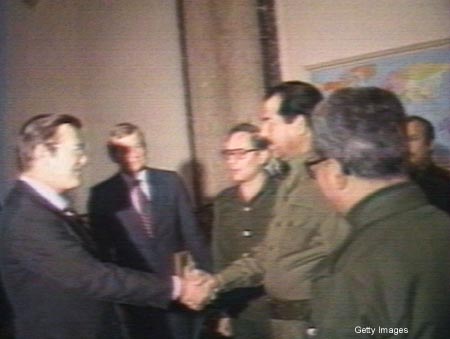
Rumsfeld's Handshake Deal with Saddam


by Norman Solomon

Christmas came 11 days early for Donald Rumsfeld two years ago when the news broke that American forces had pulled Saddam Hussein from a spidery hole. During interviews about the capture, on CBS and ABC, the Pentagon's top man was upbeat. And he didn't have to deal with a question that Lesley Stahl or Peter Jennings could have logically chosen to ask: "Secretary Rumsfeld, you met with Saddam almost exactly 20 years ago and shook his hand. What kind of guy was he?"

Now, Saddam Hussein has gone on trial, but such questions remain unasked by mainstream U.S. journalists. Rumsfeld met with Hussein in Baghdad on behalf of the Reagan administration, opening up strong diplomatic and military ties that lasted through six more years of Saddam's murderous brutality.

As it happens, the initial trial of Saddam and co-defendants is focusing on grisly crimes that occurred the year before Rumsfeld gripped his hand. "The first witness, Ahmad Hassan Muhammad, 38, riveted the courtroom with the scenes of torture he witnessed after his arrest in 1982, including a meat grinder with human hair and blood under it," the New York Times reported Tuesday. And: "At one point, Mr. Muhammad briefly broke down in tears as he recalled how his brother was tortured with electrical shocks in front of their 77-year-old father."

The victims were Shiites -- 143 men and adolescent boys, according to the charges -- tortured and killed in the Iraqi town of Dujail after an assassination attempt against Saddam in early July of 1982. Donald Rumsfeld became the Reagan administration's Middle East special envoy 15 months later.

On Dec. 20, 1983, the Washington Post reported that Rumsfeld "visited Iraq in what U.S. officials said was an attempt to bolster the already improving U.S. relations with that country." A couple of days later, the New York Times cited a "senior American official" who "said that the United States remained ready to establish full diplomatic relations with Iraq and that it was up to the Iraqis."

On March 29, 1984, the Times reported: "American diplomats pronounce themselves satisfied with relations between Iraq and the United States and suggest that normal diplomatic ties have been restored in all but name." Washington had some goodies for Saddam's regime, the Times account noted, including "agricultural-commodity credits totaling $840 million." And while "no results of the talks have been announced" after the Rumsfeld visit to Baghdad three months earlier, "Western European diplomats assume that the United States now exchanges some intelligence on Iran with Iraq."

A few months later, on July 17, 1984, a Times article with a Baghdad dateline sketchily filled in a bit more information, saying that the U.S. government "granted Iraq about $2 billion in commodity credits to buy food over the last two years." The story recalled that "Donald Rumsfeld, the former Middle East special envoy, held two private meetings with the Iraqi president here," and the dispatch mentioned in passing that "State Department human rights reports have been uniformly critical of the Iraqi President, contending that he ran a police state."

Full diplomatic relations between Washington and Baghdad were restored 11 months after Rumsfeld's December 1983 visit with Saddam. He went on to use poison gas later in the decade, actions which scarcely harmed relations with the Reagan administration.

As the most senior U.S. official to visit Iraq in six years, Rumsfeld had served as Reagan's point man for warming relations with Saddam. In 1984, the administration engineered the sale to Baghdad of 45 ostensibly civilian-use Bell 214ST helicopters. Saddam's military found them quite useful for attacking Kurdish civilians with poison gas in 1988, according to U.S. intelligence sources. "In response to the gassing," journalist Jeremy Scahill has pointed out, "sweeping sanctions were unanimously passed by the U.S. Senate that would have denied Iraq access to most U.S. technology. The measure was killed by the White House."

The USA's big media institutions did little to illuminate how Washington and business interests combined to strengthen and arm Saddam Hussein during many of his worst crimes. "In the 1980s and afterward, the United States underwrote 24 American corporations so they could sell to Saddam Hussein weapons of mass destruction, which he used against Iran, at that time the prime Middle Eastern enemy of the United States," writes Ben Bagdikian, a former assistant managing editor of the Washington Post, in his book The New Media Monopoly. "Hussein used U.S.-supplied poison gas" against Iranians and Kurds "while the United States looked the other way."

Of course the crimes of the Saddam Hussein regime were not just in the future when Rumsfeld came bearing gifts in 1983. Saddam's large-scale atrocities had been going on for a long time. Among them were the methodical torture and murders in Dujail that have been front-paged this week in coverage of the former dictator's trial; they occurred 17 months before Rumsfeld arrived in Baghdad.

Today, inside the corporate media frame, history can be supremely relevant when it focuses on Hussein's torture and genocide. But the historic assistance of the U.S. government and American firms is largely off the subject and beside the point.

A photo of Donald Rumsfeld shaking Saddam's hand on Dec. 20, 1983, is easily available. (It takes a few seconds to find via Google.) But the picture has been notably absent from the array of historic images that U.S. media outlets are providing to viewers and readers in coverage of the Saddam Hussein trial. And journalistic mention of Rumsfeld's key role in aiding the Iraqi tyrant has been similarly absent. Apparently, in the world according to U.S. mass media, some history matters profoundly and some doesn't matter at all.

Norman Solomon is the author of the new book "War Made Easy: How Presidents and Pundits Keep Spinning Us to Death." For information, go to: www.WarMadeEasy.com.

Mission to be decided

Now that so many Americans -- even Democrats! -- seem to agree that we should withdraw from Iraq soon, it's time to figure out how.
By Joe Conason

Dec. 09, 2005 | At a time when a majority of Americans are wondering why we invaded Iraq and worrying about the potential outcome of that conflict, Howard Dean said exactly the wrong thing the other day. By suggesting that the war "cannot be won" by our troops, the Democratic National Committee chairman provided President Bush with a badly needed distraction from his failing policies. His clumsy remark also served to highlight the divisions among congressional Democrats over the war and their difficulty in formulating a plausible alternative, and to isolate him from other party leaders who don't want to be associated with his remarks.

Although Dean now insists that he was quoted "a little out of context" -- and that in fact he believes "we have to win" the war -- his comment in San Antonio Monday offered every conservative pundit and Republican flack the perfect opportunity to portray Democrats as defeatists. Citizens across the political spectrum are well aware of the futility of the Bush strategy and the president's terrible mismanagement of the war, but their doubts about the likelihood of victory are not the same as admitting defeat. Talking about getting out requires very careful attention to national pride and honor, emotions that are easily subject to manipulation by the unscrupulous politicians in power.

Now that public doubt is so widespread, Democrats ought to be able to discuss the realities of the war candidly, without falling into such obvious traps. The question that we face is not whether to withdraw U.S. troops but how and when and under what conditions.

President Bush says we cannot leave until the mission is accomplished, without adequately defining what that means or how many years he expects the mission to require. He cannot explain how he plans to continue supporting this exceptionally costly venture, which is breaking our budgets and damaging our armed forces. And Bush's optimistic projections about the creation of a viable Iraqi army have been contradicted not only by nonpartisan observers but also by his own generals and the vice president of Iraq. Meanwhile, the presence of foreign troops exacerbates the insurgency, attracts fighters from other Arab nations and promotes Islamist extremism among young Muslims.

Many Democrats believe that we should begin to leave soon, regardless of conditions in Iraq and the consequences of a rapid withdrawal. Their proposed timetables for the return of U.S. troops range from six months to two years. The advocates of more rapid withdrawal argue, as Rep. John Murtha has proposed, that American troops should be "redeployed" elsewhere in the region as an "anti-terror strike force," presumably anticipating the collapse of Iraq into civil war and the establishment of Taliban-style terrorist bases in the failed Iraqi state. But such proposals also could mean that after leaving, our troops would eventually be drawn back into an Iraqi civil war that had expanded into a regional conflagration.

So we stay indefinitely or we leave swiftly, risking disaster either way. We owe the Iraqis and ourselves a better solution, and the truth is that so far we haven't tried hard enough to find one. What we should be seeking -- and what Democrats should be advocating -- is what Juan Cole calls "winning smart."

For most Americans, who initially supported the war because of the president's misleading warnings of an imminent threat from Saddam Hussein, our troops have already achieved what they set out to do. Saddam has been ousted and put in the dock for his crimes, while thorough searching has shown that there is no dangerous arsenal in Iraq. Now we need a careful plan to withdraw that creates as little collateral damage as possible.

As I've suggested previously, that requires negotiation of a settlement between the Iraqi government and the Sunni insurgency, perhaps brokered by the United Nations with the encouragement of the U.S. and British governments. Those talks would proceed from a simple premise: The foreign occupiers would set a timetable for departure if the insurgents agreed to stop fighting and pursue their interests without violence.

And for a fraction of the price we are now paying to prosecute the war, we could simultaneously offer substantial financial inducements to the Sunni tribal leaders (who have been encouraging resistance because they have lost status and wealth).

There are many reasons to think such an approach might work.

Independent reports on the insurgents, notably by the International Institute of Strategic Studies, say that they are motivated mainly by the presence of foreign troops on Iraqi soil. That is why prolonging the occupation indefinitely is so destructive, and why a conditional commitment to leave might induce many of the insurgents to talk peace. The Iraqi government evidently agrees, because its leaders have publicly suggested that they are willing to talk to the insurgents and want a timetable for U.S. withdrawal.

Even if most of the insurgents sit down to negotiate, however, there will surely be a "rejectionist" faction led by Abu Musab al-Zarqawi and his fellow Islamist militants. But that doesn't really matter. While the occupation now unites the disparate forces of the resistance, most Iraqis regard Zarqawi as a foreigner and an enemy. Once the native Sunni insurgents enter into a political settlement, he and the other Islamists will soon be isolated -- and eliminated. That would represent a decisive defeat for al-Qaida inflicted at the hands of fellow Muslims.

A better outcome for the civilized world is difficult to imagine.


Thursday, December 08, 2005

Playwright Takes a Prize and a Jab at U.S.

By SARAH LYALL

LONDON, Dec. 7 - The playwright Harold Pinter turned his Nobel Prize acceptance speech on Wednesday into a furious howl of outrage against American foreign policy, saying that the United States had not only lied to justify waging war against Iraq but had also "supported and in many cases engendered every right-wing military dictatorship" in the last 50 years.

"The crimes of the United States have been systematic, constant, vicious, remorseless, but very few people have actually talked about them," Mr. Pinter said. "You have to hand it to America. It has exercised a quite clinical manipulation of power worldwide while masquerading as a force for universal good. It's a brilliant, even witty, highly successful act of hypnosis."

Sitting in a wheelchair, his lap covered by a blanket, his voice hoarse but unwavering, Mr. Pinter, 75, delivered his speech via a video recording that was played on Wednesday at the Swedish Academy in Stockholm. Doctors told him several years ago that he had cancer of the esophagus and recently ordered him not to travel to Stockholm for the speech, his publisher said.

The playwright, known in recent years as much for his fiery anti-Americanism as for his spare prose style and haunting, elliptical plays like "The Caretaker" and "The Homecoming," was awarded the $1.3 million Nobel literature prize in October. In its citation, the Swedish Academy made little mention of his political views, saying only that he is known as a "fighter for human rights" whose stands are often "seen as controversial." It mostly focused on his work, saying that Mr. Pinter "uncovers the precipice under everyday prattle and forces entry into oppression's closed rooms."

The literature prize has in recent years often gone to writers with left-wing ideologies. These include the European writers José Saramago of Portugal, Günter Grass of Germany and Dario Fo of Italy.

When he won the award, Mr. Pinter said he did not know if the academy, whose deliberations and reasoning are kept secret, had taken his politics into account. He clearly welcomed the platform the award gave him to bring his views, long expressed in Britain, to a larger audience.

Dressed in black, bristling with controlled fury, Mr. Pinter began by explaining the almost unconscious process he uses to write his plays. They start with an image, a word, a phrase, he said; the characters soon become "people with will and an individual sensibility of their own, made out of component parts you are unable to change, manipulate or distort."

"So language in art remains a highly ambiguous transaction," he continued, "a quicksand, a trampoline, a frozen pool which might give way under you, the author, at any time."

But while drama represents "the search for truth," Mr. Pinter said, politics works against truth, surrounding citizens with "a vast tapestry of lies" spun by politicians eager to cling to power.

Mr. Pinter attacked American foreign policy since World War II, saying that while the crimes of the Soviet Union had been well documented, those of the United States had not. "I put to you that the United States is without doubt the greatest show on the road," he said. "Brutal, indifferent, scornful and ruthless it may be, but it is also very clever. As a salesman it is out on its own and its most saleable commodity is self-love."

He returned to the theme of language as an obscurer of reality, saying that American leaders use it to anesthetize the public. "It's a scintillating stratagem," Mr. Pinter said. "Language is actually employed to keep thought at bay. The words 'the American people' provide a truly voluptuous cushion of reassurance. You don't need to think. Just lie back on the cushion. The cushion may be suffocating your intelligence and your critical faculties but it's very comfortable."

Accusing the United States of torturing terrorist suspects in Guantánamo Bay and Abu Ghraib, Mr. Pinter called the invasion of Iraq - for which he said Britain was also responsible - "a bandit act, an act of blatant state terrorism, demonstrating absolute contempt for the concept of international law." He called for Prime Minister Tony Blair to be tried before an international criminal court.

Mr. Pinter said it was the duty of the writer to hold an image up to scrutiny, and the duty of citizens "to define the real truth of our lives and our societies."

"If such a determination is not embodied in our political vision, we have no hope of restoring what is so nearly lost to us - the dignity of man," he said.


Iceberg? What Iceberg?


washingtonpost.com

House Passes 3 Tax Cuts, Plans a 4th
Cost Would Outstrip Recent Action on Deficit


By Jonathan Weisman
Washington Post Staff Writer
Thursday, December 8, 2005; A01

The House passed three separate tax cuts yesterday and plans to approve a fourth today, trimming the federal revenue by $94.5 billion over five years -- nearly double the budget savings that Republicans muscled through the House last month.

GOP leaders portray the tax bills -- for the hurricane-ravaged Gulf Coast, affluent investors, U.S. troops serving in Iraq and taxpayers who otherwise would be hit by the alternative minimum tax -- as vital to keeping the economy rolling.

"Our economic policies have done the trick," said Rep. Deborah Pryce (R-Ohio). "We are in the middle of one of the strongest economies this country has ever seen."

But some budget analysts say the flourish of tax cutting badly undermines the recent shows of fiscal discipline. Last month's budget-cutting bill would save $50 billion over five years by imposing new fees on Medicaid recipients, trimming the food stamp rolls, squeezing student lenders and cutting federal child support enforcement.

"I don't think it makes any sense to go through all the difficulty they just went through with the budget-cutting bill, then give it all back in tax cuts," said Robert L. Bixby, executive director of the Concord Coalition, a nonpartisan budget watchdog group. "If they want to cut taxes, fine, but they are going to have to cut spending by at least that much to help the deficit, and clearly they are not willing to do that. They have to start looking reality in the face."

Under rules reserved for the least controversial bills, the House yesterday approved three tax bills in rapid succession. The first, at a cost of $31.2 billion, would slow the expansion of the alternative minimum tax, a parallel income tax system designed to prevent the rich from dodging taxation but that increasingly has affected the middle class.

The next, at a cost of $7.1 billion over five years, would provide an array of tax breaks to create President Bush's proposed Gulf Opportunity Zone in the region ravaged by hurricanes Katrina and Rita. Businesses could write off much of the cost of new structures and equipment, while the states of Louisiana, Mississippi and Alabama would be granted tax-exempt bond authority for their own rebuilding.

Bowing to pressure from Rep. Frank R. Wolf (R-Va.) and other social conservatives, GOP leaders exempted casinos, country clubs, hot tub facilities, liquor stores, massage parlors, golf courses, racetracks and tanning salons from the tax breaks, exemptions the administration initially opposed.

Finally, the House passed a modest, $153 million tax break that would extend a provision allowing members of the military to use their combat pay to claim the earned income credit.

The three measures passed overwhelmingly, with virtually all Democrats voting with Republicans, and with hardly a mention of their impact on the deficit, which is projected to reach $331 billion in fiscal 2006 and remain above $300 billion a year through the end of the decade, when most of Bush's tax cuts are set to expire. The Senate has already passed similar measures, indicating that all the measures are likely to become law.

The House voted 414 to 4 to spare 17 million individuals and families from paying the alternative minimum tax next year. Democratic Reps. Jerry F. Costello (Ill.), Collin C. Peterson (Minn.), Martin O. Sabo (Minn.) and Robert C. "Bobby" Scott (Va.) voted against the measure.

In a highly partisan atmosphere, tax cutting without regard to the growing federal debt appears to be one area that both parties can agree on, said Maya MacGuineas, president of the Committee for a Responsible Federal Budget. "Everybody's losing credibility right now," she said.

Debate will be considerably more rancorous today, when the House votes on a $56 billion tax package, the centerpiece of which would extend the 2003 cuts on the tax rates on dividends and capital gains through 2010. Those provisions alone would cost the Treasury $20.6 billion through 2010 and nearly $51 billion through 2015, according to the congressional Joint Committee on Taxation.

Some moderate Republicans have expressed misgivings about those cuts, which overwhelmingly benefit affluent investors, especially as Congress moves to cut programs for the poor in the name of deficit reduction. But House GOP leaders expressed confidence yesterday that the tax cuts will pass, saying that the cuts would add to the tax revenue by generating more economic growth.

"By cutting taxes, you grow the economy, and you generate an enhanced flow of revenues to the Treasury," said Rep. David Dreier (R-Calif.), chairman of the House Rules Committee.

Although the federal tax revenue has grown since the passage of the 2003 tax cuts -- from $1.9 trillion in 2004 to $2.1 trillion in 2005 -- the tax revenue measured against the size of the economy remains below the 2002 level and well below the level of 2001, when the first of Bush's five tax cuts was passed. "The argument that tax cuts will grow the economy and pay for themselves is very attractive, but it's just not true," MacGuineas said.

Today's vote on the capital gains and dividend tax cut extension promises to bring out the deficit-reduction rhetoric that was absent yesterday. In 2003, Congress lowered the tax rate on dividends to 15 percent from as high as 38.5 percent. The rate on most capital gains was lowered to 15 percent from 20 percent.

Democrats have long charged that the cuts overwhelmingly benefited the affluent. The liberal watchdog group Citizens for Tax Justice says that the richest 1 percent of Americans, with an average income of almost $1.3 million in 2009, would enjoy 53 percent of the value of the extension that year, while 78 percent would receive no benefit.

A recent study by economists at the Federal Reserve concluded that the dividend tax cut had no real impact on the stock market and prompted "only muted gain in total corporate payouts."

In contrast, Americans for Tax Reform maintains that dividend payouts among the largest companies have jumped 59 percent, while the number of firms offering dividends soared after the tax cuts.
© 2005 The Washington Post Company

Push the Pedal To the Metal or Get the Hell Out.

The New York Times
December 8, 2005
Op-Ed Columnist
Sharing the Sacrifice, or Ending It
By BOB HERBERT

If it is true, as President Bush and many others have argued, that horrific consequences will result if American forces are pulled from Iraq in the near future, then how is it that we are even considering a significant drawdown of troops in advance of next fall's Congressional elections?

Opponents of a swift withdrawal speak of potential consequences that are dire in the extreme: the eruption of a wider civil war with ever more horrendous Iraqi casualties; the transformation of Iraq into a safe haven and even more of a training ground for anti-American terrorists; the involvement of neighboring countries like Iran, Syria and Turkey in a spreading conflict that could destabilize the entire Middle East.

Vice President Dick Cheney told troops at Fort Drum, N.Y., on Tuesday that in the event of a swift withdrawal of American troops, Iraq "would return to the rule of tyrants, become a massive source of instability in the Middle East and be a staging area for ever greater attacks against America and other civilized nations."

Senator John McCain, who defines "complete victory" in Iraq as the establishment of a "flawed but functioning democracy," told Tim Russert of NBC that achieving even that modest goal would be "long and hard and tough."

If the hawks are right, if all of this is so - and if this war is, indeed, still winnable - then the Bush administration has an obligation to level with the American people, explaining clearly what will be required in terms of casualties, financial costs and other sacrifices, and telling the truth about the shabby, amateurish state of the Iraqi security forces.

As it stands now, the United States is incapable of defeating the insurgency with the forces it has in Iraq. So it is beyond preposterous to think that Iraq can be pacified in a year or 18 months or two years by a fledgling, underequipped Iraqi Army and a hapless police force riddled with brutal, partisan militias.

What's more, the U.S. military itself is in danger of cracking under the strain of this endless Iraq ordeal. Troops are being sent into the war zone for their third and fourth tours, which is hideously unfair. The more times you roll the dice, the more likely snake eyes will pop up.

Even with lowered standards, the Army can't meet its recruitment goals. And the National Guard and Reserves have been all but exhausted by the war effort.

The combination of troop shortages, declining public support for the war and the Republicans' anxiety over next year's elections all but ensures some substantial reduction in U.S. forces in Iraq over the next eight to 12 months.

And yet the hawks say we must continue the fight. Well, wars fought with one eye on the polls and one eye on the political calendar get lots of people killed for nothing.

If this war is worth fighting, it's worth fighting right. And that means mobilizing not just the handful of troops who have borne the burden of this wretched conflict, but the entire nation. Taxes would have to be raised, the military expanded, the forces in Iraq bolstered and a counterinsurgency strategy developed that would have some chance of actually defeating the enemy.

To do that would require implementing a draft. It's easy to make the case for war when the fighting will be done by other people's children.

If this war is as important as the hawks insist it is, the burden should be shared by all of us. The youngsters sacrificed on the altar of Iraq should be drawn from the widest possible swath of the general population.

If most Americans are unwilling to send their children to fight in Iraq, it must mean that most Americans do not feel that winning the war is absolutely essential.

The truth is that no one knows for sure what will happen if we pull our troops out of Iraq. Many of those who insist that the sky will fall were insisting three years ago that Iraq had weapons of mass destruction and that invading U.S. troops would be greeted as liberators.

The public initially supported this war because the administration was very effective at promoting the canard that Iraq was somehow linked to Al Qaeda and involved in the Sept. 11 attacks.

Now the hawks must once again bear the burden of persuasion. They must persuade the public that the U.S. should continue indefinitely fighting this war, which has embedded us in such a hellish predicament and taken such a horrendous toll.

If it's not worth fighting, then we should be preparing an orderly exit now.

* Copyright 2005The New York Times Company

Wednesday, December 07, 2005

Torturing the Facts - New York Times
The New York Times

December 7, 2005
Op-Ed Columnist

Torturing the Facts
By
MAUREEN DOWD

Our secretary of state's tortuous defense of supposedly nonexistent C.I.A.
torture chambers in Eastern Europe was an acid flashback to Clintonian
parsing.

Just as Bill Clinton pranced around questions about marijuana use at Oxford
during the '92 campaign by saying he had never broken the laws of his
country,
so Condoleezza Rice pranced around questions about outsourcing torture by
suggesting that President Bush had never broken the laws of his country.

But in Bill's case, he was only talking about smoking a little joint, while
Condi is talking about snatching people off the street and throwing them
into
lethal joints.

"The United States government does not authorize or condone torture of
detainees," she said.

It all depends on what you mean by "authorize," "condone," "torture" and
"detainees."

Ms. Rice also claimed that the U.S. did not transport terrorism suspects
"for the purpose of interrogation using torture." But, hey, as Rummy likes
to say,
stuff happens.

The president said he was opposed to torture and then effectively issued
regulations to allow what any normal person - and certainly a victim - would
consider
torture. Alberto Gonzales et al. have defined torture deviancy downward to
the point where it's hard to imagine what would count as torture. Under this
administration, prisoners have been hung by their wrists and had electrodes
attached to their genitals; they've been waterboarded, exposed to extreme
heat
and cold, and threatened with death - even accidentally killed.

Does Ms. Rice think anyone is buying her loophole-riddled defense? Not with
the Italians thinking of rounding up C.I.A. officers to ask them whether
they
abducted a cleric in Milan. And with Torquemada Cheney slouching around
Capitol Hill trying to circumvent John McCain, legalizing torture at the
C.I.A.'s
secret prisons, by preventing Congress from requiring decent treatment for
U.S. prisoners.

As The Times's Scott Shane reported today, a German man, Khaled el-Masri,
says he was kidnapped, beaten and spirited away to Afghanistan by C.I.A.
officers
in an apparent case of mistaken identity in 2003.
He is suing the former C.I.A. chief George Tenet and three companies
allegedly involved in the clandestine flights.

Mr. Masri, a 42-year-old former car salesman, was refused entry to the U.S.
on Saturday. He had intended to hold a news conference in Washington
yesterday,
but ended up talking to reporters over a video satellite link, telling how
he was beaten, photographed nude and injected with drugs during five months
in detention.

Mr. Masri said through an interpreter: "I don't think I'm the human being I
used to be."

When Ms. Rice was a Stanford professor of international relations, she would
have flunked any student who dared to present her with the sort of willfully
disingenuous piffle she spouted on the eve of her European trip.

Maybe she figures that if she was able to fool people once with doubletalk
about W.M.D., she can fool them again with doubletalk about rendition.

As chatter spreads about Condi as a possible presidential contender, we are
left wondering, once more, who this woman really is. Is she doing this
willingly,
or is she hemmed in by the powerful men around her? As a former national
security adviser who has had the president's ear for five years, did she try
to
fight the appalling attempt to shred the Geneva Conventions, or did she go
along with it? Is she doing Vice's nefarious bidding on torture, just as she
did on ginning up the case for invading Iraq?

As Condi used weasel words on torture, Hillary took a weaselly position on
flag-burning. Trying to convince the conservatives that she's still got a
bit
of that Goldwater Girl in her, the woman who would be the first woman
president is co-sponsoring a Republican bill making it illegal to desecrate
the American
flag. The red staters backing this measure are generally the ones who
already can't stand Hillary, so they won't be fooled.

The senator doing Clintonian triangulating is just as transparent as the
secretary doing Clintonian parsing.

Speaking of silly masquerades, who does Judge Samuel Alito Jr. think he's
fooling by presenting himself as a reasonable jurist? Here's a guy whose
entire
career seems to be based on interfering with women's lives. He wanted to
overturn Roe v. Wade, condoned the strip search of a 10-year-old girl and
belonged
to a conservative alumni club that resisted the admission of women to
Princeton.

All in all, a bad week for women - sheer torture to watch.

Posted by Miriam V

Fw: Torture:  What are the U.S. Obligations to Prevent? - FCNL


----- Original Message -----
From: "Kathy Guthrie" <kathyguthrie@fcnl.org>
To: "Miriam Vieni" <miriamvieni@optonline.net>
Sent: Wednesday, December 07, 2005 1:17 PM
Subject: Torture: What are the U.S. Obligations to Prevent? - FCNL

Torture: What are the U.S. Obligations to Prevent? - FCNL

The Bush administration this week publicly attempted to narrow the
definition of torture and limit the responsibility of individuals
working for the U.S. government to prevent torture from taking place.
But U.S. military leaders and many members of Congress from both
parties are refusing to stand aside while fundamental rights are
eroded.

Behind-the-scenes arguments came dramatically into public view recently
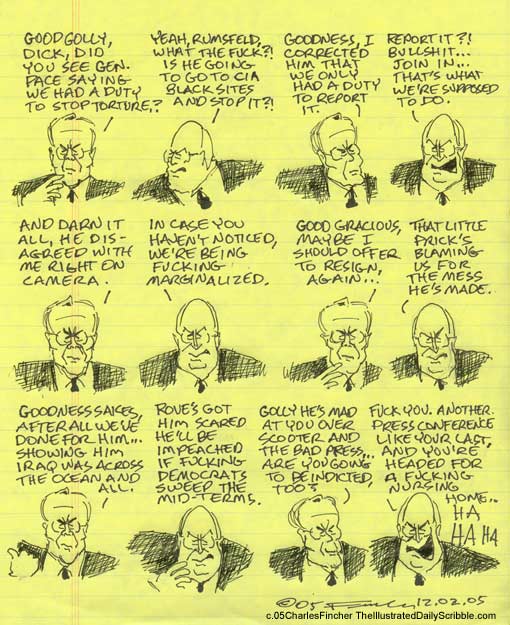
when Secretary of Defense Donald Rumsfeld argued that military
personnel have no obligation to intervene when they personally witness
torture taking place by officials of other, sovereign governments.
Standing next to Rumsfeld at a press conference last week, the Chairman
of the Joint Chiefs of Staff, General Peter Pace, responded: "It
is absolutely the responsibility of every U.S. service member, if they
see inhumane treatment being conducted, to intervene to stop it."

But the secretary of defense didn't agree: "I don't think you mean
they have an obligation to physically stop it." In a rare direct,
public confrontation, the chairman of the joint chiefs stood his
ground: "If they [U.S. soldiers] are physically present when inhumane
treatment is taking place, sir, they have an obligation to try to stop
it," Pace told the secretary of defense.

Following this exchange, The Washington Post reported that the
secretary of defense has asked the Pentagon to review guidelines for
soldiers operating in these conditions. Read a letter from FCNL's Col.
Dan Smith (USA Ret.) to Gen. Pace supporting Pace's position at
http://www.fcnl.org/issues/item.php?item_id=1645&issue_id=67.

This public debate within the executive branch on appropriate
responses to torture comes as the U.S. government has come under new
scrutiny by European governments. The European Union expressed concern
about public reports that the U.S. is holding some prisoners in secret
prisons in Eastern Europe without granting them access to legal counsel
or the International Committee of the Red Cross.

The secret detention facilities in Eastern Europe and other areas of
the world are part of a shadowy network of detention and interrogation
facilities set up by the U.S. government to circumvent legal
restrictions on interrogation, torture, and due process of law,
according to reports from Human Rights Watch and some press accounts.
Read a Human Rights Watch report on government treatment of detainees
at:
http://www.fcnl.org/issues/item.php?item_id=1644&issue_id=70.

But the public disclosure of these facilities and the acknowledgment by
Secretary of State Condolezza Rice that these facilities have been used
in Europe have persuaded some European governments to call for the shut
down of these secret prisons.

The public debate on interrogation, torture, and secret detention
facilities has persuaded many members of Congress to support
legislation offered by Sen. John McCain (AZ) that would establish clear
guidelines for interrogation that prohibit torture. The New York Times
reported December 7 that the White House has "all but abandoned its
effort to persuade Sen. McCain to exempt Central Intelligence Agency
employees from legislation barring inhumane or degrading treatment of
prisoners in American custody." If true, that is a victory on which we
can and must build.

Although we citizens should be able to take for granted that our
government opposes and strenuously prohibits torture, we cannot. Our
government officials are engaged in an intense debate whether some
agents of the U.S. government should be able to engage in some types of
torture of certain kinds of suspects. Now the White House is seeking
to limit the penalties imposed on U.S. government personnel who engage
in torture.

The public outcry against torture is strengthening the hand of those
within the U.S. government who oppose torture and want to prohibit its
use. We want to encourage all our FCNL constituents to back them up
with informed comment and with encouragement to sustain government
advocates of a world free from the threat of torture. Read more about
these issues at http://www.fcnl.org/issues/issue.php?issue_id=67

_______________________________________

Stop New Nuclear Weapons! Find out how, http://www.fcnl.org/nuclear/
The Next Step for Iraq: Join FCNL's Iraq Campaign, http://www.fcnl.org/iraq/

Contact Congress and the Administration:
http://capwiz.com/fconl/dbq/officials/

Order FCNL publications and "War is Not the Answer" campaign
bumper stickers and yard signs:
http://www.fcnl.org/pubs/
http://www.fcnl.org/forms/forms.php?type=bump

Contribute to FCNL:
http://www.fcnl.org/donate/

Subscribe or update your information to this list:
http://capwiz.com/fconl/mlm/. To unsubscribe from this list, please see
the end of this message.

Subscribe to other FCNL legislative, policy, and action alert lists:
http://www.fcnl.org/forms/forms.php?type=ls.
________________________________________

Friends Committee on National Legislation
245 Second St. NE, Washington, DC 20002-5795
fcnl@fcnl.org * http://www.fcnl.org
phone: (202)547-6000 * toll-free: (800)630-1330

We seek a world free of war and the threat of war
We seek a society with equity and justice for all
We seek a community where every person's potential may be fulfilled
We seek an earth restored.

---
If you no longer wish to receive e-mail from us, please visit
http://capwiz.com/fconl/lmx/u/?jobid=62434743&queueid=555616496.

Tuesday, December 06, 2005

Dick and Don Chew the Fat

Open and Shut

Four years later, we still have ten big questions

by Jarrett Murphy
December 5th, 2005 6:30 PM

On Monday, December 5, the 9-11 Public Discourse Project—a private group formed by 9-11 Commission members after their official mandate lapsed in 2004—held a wrap-up press briefing in Washington, signaling the last gasp of official inquiries into the attacks four years ago. The National Institute of Standards and Technology also recently completed its final report on the twin towers. Already gathering dust are a Federal Emergency Management Agency study, the joint inquiry by Congress, the McKinsey reports on New York City's emergency response, probes by federal inspectors general, and other efforts to resolve the myriad doubts about the hijackings.
Some questions can't be answered: People who lost loved ones will never know exactly how the end came, if it hurt, what the final thoughts and words were. But other questions are more tractable. Here are 10 of them:

1. Where was the "National Command Authority"?

There has never been a true accounting of why the nation's leaders were out of the loop for so long that morning. George W. Bush and his aides even have told different versions of how the president was actually informed of the first plane striking: The president claimed erroneously that he saw it on TV, while chief of staff Andrew Card said it was Karl Rove who told the president. According to the official version, after Rove told Bush, the president talked to then national-security adviser Condoleezza Rice. She told him about the crash but apparently did not know about the reported hijacking of American Airlines Flight 11, which military air defenses learned about 17 minutes earlier.

Secretary of Defense Donald Rumsfeld was informed of the second plane hitting the WTC—yes, the second plane—during his intelligence briefing but continued the briefing and was at his desk when Flight 77 struck the Pentagon.

Together, the president and secretary of defense are the National Command Authority that is supposed to lead the country in the case of military emergency. But Bush didn't get in touch with Rumsfeld until after 10 a.m., around the time the fourth and final plane crashed in Shanksville, Pennsylvania. When Bush was criticized days after 9-11 for failing to return to Washington until more than 10 hours after the first attack, the White House claimed there had been a threat ("real and credible," in flack Ari Fleischer's words) to Air Force One. There was none. All the 9-11 Commission says of this phantom threat is that it was the product of "a misunderstood communication."

2. Who gave the order to try to shoot the planes down?

The commission is noticeably vague on this point. The official version says Dick Cheney told the military a little past 10 a.m. to shoot down a threatening plane, claiming that the president had given his approval for the order. But while a few people in the White House bunker noted a call between Cheney and Bush moments earlier, only Rice says she heard Cheney bring up the shoot-down order. Despite the fact that people at both ends of the call were taking notes, the commission found that "there is no documentary evidence of this call." Meanwhile, some of the fighter jets in the air over D.C. received no orders to shoot down planes, while other military aircraft got the OK from the Secret Service to fly "weapons free," which means they had wide authority to take out suspicious aircraft.

Since the military was given little or no notice about the planes, maybe it doesn't matter who authorized a shoot-down. But the record is unclear. Neither Cheney nor Bush testified under oath before the 9-11 panel, in public or private.

3. What exactly were all those firefighters doing in the towers?

Reports on the disaster reflect confusion over the exact mission of the firefighters who climbed the twin towers, many of whom died. The 9-11 Commission says fire chiefs decided early on that because the fire was so big, their job would "primarily be one of rescue." But NIST reports that some fire commanders thought their men would fight fires to save people trapped above them, and individual fire companies thought their mission was to "get up to the fire as soon as possible, put the fire out, and get ready for their next assignment." According to oral histories collected by the FDNY, some firefighters were told to head up the stairs carrying hoses, and others to drop their hoses in the lobby. Some were ordered simply to head up the stairs without a clear idea of where they were going or why.

While it is doubtless that first responders saved lives that day, it's not clear that there were many people left to be rescued when late-arriving firefighters began climbing the stairs, especially in the north tower. Mayors Giuliani and Bloomberg have said up to 25,000 people escaped the towers; NIST has put that figure at around 15,000—still a blessing. But NIST believes that 90 percent of those civilians who survived started descending both towers before the second plane hit. (About 1,000 of them were "mobility impaired" and needed help getting out.) Just shy of 2,000 of the roughly 2,150 civilians who died in the towers were trapped above the impact zones, with no chance of rescue.

4. Did anyone think the towers would collapse?

Reports on the FDNY response to 9-11 generally agree that, as the FDNY-commissioned McKinsey study put it, "Chief officers considered a limited, localized collapse of the towers possible, but did not think that they would collapse entirely." For some of the fire officers, that confidence might have been based on a misconception about how the towers were built: The FDNY chief of safety says in his oral history that he thought the towers were made of block construction, with a solid concrete core, so that fire crews would have at least three hours to work. In fact, the cores of the towers were sheetrock over steel. And the citywide safety chief in charge that day didn't know a plane had hit the north tower.

Evidently, fears about collapse evolved as the disaster wore on. Peter Ganci, the highest ranking chief and one of the 343 fire personnel who died, reportedly told the commander in the north-tower lobby at 9:45 a.m. that he might want to consider an evacuation—almost 45 minutes before that building collapsed. Assistant Chief Joseph Callan, the citywide tour commander that day, told investigators: "Approximately 40 minutes after I arrived in the lobby I made a decision that the building was no longer safe and that was based on the conditions in the lobby—large pieces of plaster falling, all the 20-foot-high glass panels on the exterior of the lobby were breaking, there was obvious movement of the building, and that was the reason on the handy talky I gave the order for all fire department units to leave the north tower. Approximately ten minutes after that we had collapse of the south tower." Fire chiefs also received—just moments before the south tower fell—a report that someone from the city's Office of Emergency Management thought the towers weren't structurally sound. The source of that report is unknown.

5. Why was Giuliani's command bunker at ground zero?

A constant refrain in rehashes of 9-11 is that the cooperation between police and fire services that day was poor. The OEM was unable to bridge the gap because it was busy evacuating its own emergency center in 7 WTC. "The loss of the OEM operations center," NIST found, "created difficulties related to the coordination of emergency responder operations and resources." Because the World Trade Center had been a terrorist target in 1993, Giuliani was criticized in 1998 for his decision to locate the emergency center there. Yet when Giuliani and Jerry Hauer (who was OEM director when the 7 WTC site was picked) appeared before the 9-11 Commission, no one asked them about the bunker. Nor did commissioners ask Giuliani specifically why firefighters were using the same radios on 9-11 that had worked so poorly in the '93 bombing. Part of the reason was the city had broken contracting rules when it purchased new radios earlier in 2001, and those radios had to be withdrawn because of technical problems.

6. Why did 7 WTC fall?

Seven World Trade Center—where, besides OEM, the CIA, Salomon Smith Barney, and other entities had offices—was the last building to collapse on 9-11. It was also probably the first steel skyscraper anywhere to collapse solely because of fire. We still don't know why. While NIST has completed its twin towers reports, it has delayed its 7 WTC report twice; it's currently not expected until next spring.

Several 7 WTC tenants, including OEM and the Secret Service, had tanks filled with diesel fuel to power emergency generators. If that fuel leaked and burned, it may have heated the building's steel supports to the point of failure, but according to FEMA's report on the collapse this "best hypothesis has only a low probability of occurrence."

7. How did the twin towers fall?

Many FDNY personnel who saw the south tower collapse reported explosions at the lower levels as the top began collapsing. These reports, as well as "squibs" of smoke seen on video of the collapses, have led to theories that the towers were brought down in controlled explosions. NIST dismisses these notions, claiming that the puffs of smoke were the result of air being forced down by the top of the tower collapsing.

NIST said the towers fell because the planes shook fireproofing loose from the steel superstructure, and the fire heated the floor-supporting trusses so much that they pulled in on support columns that were already holding more than their regular load. But NIST's computer simulation stops at the point the collapse begins, and does not document exactly how the rest of the buildings crumbled in 10 seconds. The reason for this omission could be the sheer complexity of the computations—even NIST's simplified model took weeks to run on a computer.

Conspiracy theorists aren't the only ones who dispute NIST's version: Some fire scientists also take issue with the institute's methods and conclusions. And the point isn't just historical. The lessons learned from the WTC collapse will inform decisions about the safety of other modern office towers.

8. How dangerous was—and is—the air at ground zero?

A few days after the towers fell, the Environmental Protection Agency announced that tests of air and water near the WTC site "indicate that these vital resources are safe." The only problem was, as the EPA's inspector general reported later, the agency "did not have sufficient data and analyses to make such a blanket statement." What's more, the inspector general said, "the White House Council on Environmental Quality influenced, through the collaboration process, the information that EPA communicated to the public."

The 9-11 Commission did not address this topic in the body of its final report. In a single footnote, the panel said it didn't have the expertise to talk about the air testing, but let the White House off the hook for influencing EPA press releases. Then–EPA head Christine Whitman told the commission that she had met with a top Bush economic adviser "regarding the need to get financial markets open quickly," but denied any pressure to fudge the air quality readings. A group of 12 people has sued the EPA over health problems they blame on poor air quality near the site after the attacks. Meanwhile, the EPA just last week approved a plan to test and clean apartments south of Canal Street.

9. What exactly did Zacarias Moussaoui plan to do?

Was he the 20th hijacker? Or was he supposed to pilot a fifth plane on September 11? Or was he a backup for Ziad Jarrah, the Flight 93 hijack pilot, whose disagreements with Mohammed Atta almost got him dropped from the plot? Or was he a pilot for a "second wave" of attacks, as captured Al Qaeda leader Khalid Shaikh Mohammed is quoted saying in the 9-11 Commission report?

Last April, Moussaoui pled guilty to conspiracy charges, but claimed that he had nothing to do with 9-11 and instead was planning a separate attack to try to free Sheikh Omar Abdel Rahman.

The Department of Justice hasn't said publicly exactly what Moussaoui did—stating in court filings merely that Moussaoui "participated" in the 9-11 plot—but it does want to execute him for his alleged role

10. What's on those blanked-out pages?

"The Joint Inquiry Into Intelligence Community Activities Before and After the Terrorist Attacks of September 11, 2001," which was released in late 2002, included 28 pages that were blanked out, apparently concerning the possible role of Saudi government officials. Those aren't the only blank spots in the public record. As the Voice reported in October, there are multiple redactions in the FDNY oral histories that in some cases seem to concern the radios or suspicious activity near the WTC site before and during the attacks.


Monday, December 05, 2005

The Iraq Index

by JOHN S. FRIEDMAN

As the debate about when and how to exit Iraq intensifies, it is essential to have information that is accessible and that puts the human costs of the war in context.

More American soldiers have died in Iraq than in all US conflicts put together since Vietnam. About eight times more soldiers have died in Iraq than in Afghanistan and all other countries where the United States is fighting terrorism, combined. Most of those who have died came from poor, rural areas. The smaller US territories and commonwealths are paying the greatest price. American Samoa, the Northern Mariana Islands and the Virgin Islands have the highest number of deaths per capita. On the other hand, Puerto Rico has the second-lowest number. Of the states, Vermont has the highest and Utah the lowest number of deaths per capita.

Approximately 26 percent of those killed have been minorities. This percentage is about the same as in the Gulf War (24 percent), but much greater than in the Vietnam War (14 percent) or even Afghanistan (19 percent). Citizen soldiers (reservists and members of the National Guard) are shouldering a significant proportion of the casualties, accounting for about one-quarter of all US deaths since the war began. More than 15,500 US soldiers have been wounded--more than seven times the number who have died.

It is extremely difficult to get precise data in Iraq's chaotic war zone. The Pentagon reports the number of wounded only about twice a month, and warns that many of its statistics are subject to change. Some of the numbers compiled on these pages can only be estimates. One of the most up-to-date sources of casualty information, relying on Department of Defense data, is the Iraq Coalition Casualty Count website (icasualties.org), where dedicated volunteers keep daily track of the US victims. Other helpful sources include The Iraq Quagmire, a report by the Institute for Policy Studies (ips-dc.org); globalsecurity.org; and tedkennedy.com.

Sixty journalists have been killed in Iraq, according to the Committee to Protect Journalists. The exact number of private contractors and other civilian employees who have been killed is not known. But at least 428 have died and 3,963 have been injured, according to Knight Ridder Newspapers. Of these deaths, at least 147 are Americans, the New York Times reports. This figure is probably low; seventy-nine employees from Halliburton alone have died in Iraq, according to a company spokesperson.

The total number of Iraqis who have been killed will never be known. Recently the Pentagon reported that nearly 26,000 Iraqis had been "killed or wounded from insurgent attacks" from the beginning of 2004 to September 2005. But when you add the estimated number of Iraqis killed by American forces, the figure could be more than 100,000, according to a controversial 2004 study published in The Lancet, a respected British medical journal. Another source, iraqbodycount.org, estimates that by late November, Iraqi deaths totaled between 27,115 and 30,559.

The war has already cost the United States an estimated $251 billion. Each day an estimated $195 million is being spent--money that could provide twelve meals to every starving child in the world, according to Senator Ted Kennedy's office. In addition, one day of Iraq War expenses could cover what the College Board estimates to be the full cost of a public higher education for some 17,000 American students.

The tragedy of Iraq can never be told by numbers alone. To borrow from John Crawford's firsthand account of the war, The Last True Story I'll Ever Tell, the following chart "won't bring back anyone's son or brother or wife." But perhaps it will "simply make people aware, if only for one glimmering moment," of the terrible costs of a war that refuses to end.

Sunday, December 04, 2005

Ho Ho Hokum

The New York Times
December 4, 2005
Editorial Observer
This Season's War Cry: Commercialize Christmas, or Else
By ADAM COHEN

Religious conservatives have a cause this holiday season: the commercialization of Christmas. They're for it.

The American Family Association is leading a boycott of Target for not using the words "Merry Christmas" in its advertising. (Target denies it has an anti-Merry-Christmas policy.) The Catholic League boycotted Wal-Mart in part over the way its Web site treated searches for "Christmas." Bill O'Reilly, the Fox anchor who last year started a "Christmas Under Siege" campaign, has a chart on his Web site of stores that use the phrase "Happy Holidays," along with a poll that asks, "Will you shop at stores that do not say 'Merry Christmas'?"

This campaign - which is being hyped on Fox and conservative talk radio - is an odd one. Christmas remains ubiquitous, and with its celebrators in control of the White House, Congress, the Supreme Court and every state supreme court and legislature, it hardly lacks for powerful supporters. There is also something perverse, when Christians are being jailed for discussing the Bible in Saudi Arabia and slaughtered in Sudan, about spending so much energy on stores that sell "holiday trees."

What is less obvious, though, is that Christmas's self-proclaimed defenders are rewriting the holiday's history. They claim that the "traditional" American Christmas is under attack by what John Gibson, another Fox anchor, calls "professional atheists" and "Christian haters." But America has a complicated history with Christmas, going back to the Puritans, who despised it. What the boycotters are doing is not defending America's Christmas traditions, but creating a new version of the holiday that fits a political agenda.

The Puritans considered Christmas un-Christian, and hoped to keep it out of America. They could not find Dec. 25 in the Bible, their sole source of religious guidance, and insisted that the date derived from Saturnalia, the Roman heathens' wintertime celebration. On their first Dec. 25 in the New World, in 1620, the Puritans worked on building projects and ostentatiously ignored the holiday. From 1659 to 1681 Massachusetts went further, making celebrating Christmas "by forbearing of labor, feasting or in any other way" a crime.

The concern that Christmas distracted from religious piety continued even after Puritanism waned. In 1827, an Episcopal bishop lamented that the Devil had stolen Christmas "and converted it into a day of worldly festivity, shooting and swearing." Throughout the 1800's, many religious leaders were still trying to hold the line. As late as 1855, New York newspapers reported that Presbyterian, Baptist and Methodist churches were closed on Dec. 25 because "they do not accept the day as a Holy One." On the eve of the Civil War, Christmas was recognized in just 18 states.

Christmas gained popularity when it was transformed into a domestic celebration, after the publication of Clement Clarke Moore's "Visit from St. Nicholas" and Thomas Nast's Harper's Weekly drawings, which created the image of a white-bearded Santa who gave gifts to children. The new emphasis lessened religious leaders' worries that the holiday would be given over to drinking and swearing, but it introduced another concern: commercialism. By the 1920's, the retail industry had adopted Christmas as its own, sponsoring annual ceremonies to kick off the "Christmas shopping season."

Religious leaders objected strongly. The Christmas that emerged had an inherent tension: merchants tried to make it about buying, while clergymen tried to keep commerce out. A 1931 Times roundup of Christmas sermons reported a common theme: "the suggestion that Christmas could not survive if Christ were thrust into the background by materialism." A 1953 Methodist sermon broadcast on NBC - typical of countless such sermons - lamented that Christmas had become a "profit-seeking period." This ethic found popular expression in "A Charlie Brown Christmas." In the 1965 TV special, Charlie Brown ignores Lucy's advice to "get the biggest aluminum tree you can find" and her assertion that Christmas is "a big commercial racket," and finds a more spiritual way to observe the day.

This year's Christmas "defenders" are not just tolerating commercialization - they're insisting on it. They are also rewriting Christmas history on another key point: non-Christians' objection to having the holiday forced on them.

The campaign's leaders insist this is a new phenomenon - a "liberal plot," in Mr. Gibson's words. But as early as 1906, the Committee on Elementary Schools in New York City urged that Christmas hymns be banned from the classroom, after a boycott by more than 20,000 Jewish students. In 1946, the Rabbinical Assembly of America declared that calling on Jewish children to sing Christmas carols was "an infringement on their rights as Americans."

Other non-Christians have long expressed similar concerns. For decades, companies have replaced "Christmas parties" with "holiday parties," schools have adopted "winter breaks" instead of "Christmas breaks," and TV stations and stores have used phrases like "Happy Holidays" and "Season's Greetings" out of respect for the nation's religious diversity.

The Christmas that Mr. O'Reilly and his allies are promoting - one closely aligned with retailers, with a smack-down attitude toward nonobservers - fits with their campaign to make America more like a theocracy, with Christian displays on public property and Christian prayer in public schools.

It does not, however, appear to be catching on with the public. That may be because most Americans do not recognize this commercialized, mean-spirited Christmas as their own. Of course, it's not even clear the campaign's leaders really believe in it. Just a few days ago, Fox News's online store was promoting its "Holiday Collection" for shoppers. Among the items offered to put under a "holiday tree" was "The O'Reilly Factor Holiday Ornament." After bloggers pointed this out, Fox changed the "holidays" to "Christmases."

* Copyright 2005 The New York Times Company

Paging Frank Rich! GAO confirms - 2004 Election Was Stolen

I had a chance to talk to my hero, Frank Rich, a few months ago about election fraud and he claimed he didn't know much about it. Perhaps he has his plate full unraveling the administration's lies about Iraq, but with the midterm elections coming up someone has to take this issue on.

I was listening to NPR yesterday and they had some young computer hackers on bragging about how easy, embarrassingly easy, it is to switch votes on the Diebold machines. Bill Clinton once mentioned that India has flawless electronic voting while ours is mired in unaccountability. I hope Frank and other journalists and bloggers of his caliber read this article by Bob Fitrakis and Harvey Wasserman about the GAO report on the 2004 election. Paul Krugman and the NYTimes editorial board have been good on this issue in the past, but it has been a while since anyone has raised the subject.

The Government Accountability Office is the only government office we have left that is ethical, non-partisan and incorruptible. They investigate and tell it like it is. Thank God for them. This report is very serious and must get more attention. It has taken years for the mainstream press and Congress to finally understand what we in the blogisphere have known since 2000. This administration will distort and cheat about anything and everything to get its way. If this report got the attention it deserves and broke through the static of our 500-channel universe, it could be the coup de grace of the Bush White House.

Powerful Government Accountability Office report confirms key 2004 stolen election findings by Bob Fitrakis & Harvey Wasserman October 26, 2005

As a legal noose appears to be tightening around the Bush/Cheney/Rove inner circle, a shocking government report shows the floor under the legitimacy of their alleged election to the White House is crumbling.

The latest critical confirmation of key indicators that the election of 2004 was stolen comes in an extremely powerful, penetrating report from the Government Accountability Office that has gotten virtually no mainstream media coverage.

The government's lead investigative agency is known for its general incorruptibility and its thorough, in-depth analyses. Its concurrence with assertions widely dismissed as "conspiracy theories" adds crucial new weight to the case that Team Bush has no legitimate business being in the White House.

Nearly a year ago, senior Judiciary Committee Democrat John Conyers (D-MI) asked the GAO to investigate electronic voting machines as they were used during the November 2, 2004 presidential election. The request came amidst widespread complaints in Ohio and elsewhere that often shocking irregularities defined their performance.

According to CNN, the U.S. House Judiciary Committee received "more than 57,000 complaints" following Bush's alleged re-election. Many such concerns were memorialized under oath in a series of sworn statements and affidavits in public hearings and investigations conducted in Ohio by the Free Press and other election protection organizations.

The non-partisan GAO report has now found that, "some of [the] concerns about electronic voting machines have been realized and have caused problems with recent elections, resulting in the loss and miscount of votes."

The United States is the only major democracy that allows private partisan corporations to secretly count and tabulate the votes with proprietary non-transparent software. Rev. Jesse Jackson, among others, has asserted that "public elections must not be conducted on privately-owned machines." The CEO of one of the most crucial suppliers of electronic voting machines, Warren O'Dell of Diebold, pledged before the 2004 campaign to deliver Ohio and thus the presidency to George W. Bush.

Bush's official margin of victory in Ohio was just 118,775 votes out of more than 5.6 million cast. Election protection advocates argue that O'Dell's statement still stands as a clear sign of an effort, apparently successful, to steal the White House.

Among other things, the GAO confirms that:

1. Some electronic voting machines "did not encrypt cast ballots or system audit logs, and it was possible to alter both without being detected." In other words, the GAO now confirms that electronic voting machines provided an open door to flip an entire vote count. More than 800,000 votes were cast in Ohio on electronic voting machines, some seven times Bush's official margin of victory.

2. "It was possible to alter the files that define how a ballot looks and works so that the votes for one candidate could be recorded for a different candidate." Numerous sworn statements and affidavits assert that this did happen in Ohio 2004.

3. "Vendors installed uncertified versions of voting system software at the local level." 3. Falsifying election results without leaving any evidence of such an action by using altered memory cards can easily be done, according to the GAO.

4. The GAO also confirms that access to the voting network was easily compromised because not all digital recording electronic voting systems (DREs) had supervisory functions password-protected, so access to one machine provided access to the whole network. This critical finding confirms that rigging the 2004 vote did not require a "widespread conspiracy" but rather the cooperation of a very small number of operatives with the power to tap into the networked machines and thus change large numbers of votes at will. With 800,000 votes cast on electronic machines in Ohio, flipping the number needed to give Bush 118,775 could be easily done by just one programmer.

5. Access to the voting network was also compromised by repeated use of the same user IDs combined with easily guessed passwords. So even relatively amateur hackers could have gained access to and altered the Ohio vote tallies.

6. The locks protecting access to the system were easily picked and keys were simple to copy, meaning, again, getting into the system was an easy matter.

7. One DRE model was shown to have been networked in such a rudimentary fashion that a power failure on one machine would cause the entire network to fail, re-emphasizing the fragility of the system on which the Presidency of the United States was decided.

8. GAO identified further problems with the security protocols and background screening practices for vendor personnel, confirming still more easy access to the system.

In essence, the GAO study makes it clear that no bank, grocery store or mom & pop chop shop would dare operate its business on a computer system as flimsy, fragile and easily manipulated as the one on which the 2004 election turned.

The GAO findings are particularly damning when set in the context of an election run in Ohio by a Secretary of State simultaneously working as co-chair of the Bush-Cheney campaign. Far from what election theft skeptics have long asserted, the GAO findings confirm that the electronic network on which 800,000 Ohio votes were cast was vulnerable enough to allow a a tiny handful of operatives -- or less -- to turn the whole vote count using personal computers operating on relatively simple software.

The GAO documentation flows alongside other crucial realities surrounding the 2004 vote count. For example:

The exit polls showed Kerry winning in Ohio, until an unexplained last minute shift gave the election to Bush. Similar definitive shifts also occurred in Iowa, Nevada and New Mexico, a virtual statistical impossibility.

A few weeks prior to the election, an unauthorized former ES&S voting machine company employee, was caught on the ballot-making machine in Auglaize County

Election officials in Mahoning County now concede that at least 18 machines visibly transferred votes for Kerry to Bush. Voters who pushed Kerry's name saw Bush's name light up, again and again, all day long. Officials claim the problems were quickly solved, but sworn statements and affidavits say otherwise. They confirm similar problems inFranklin County (Columbus). Kerry's margins in both counties were suspiciously low.

A voting machine in Mahoning County recorded a negative 25 million votes for Kerry. The problem was allegedly fixed.

In Gahanna Ward 1B, at a fundamentalist church, a so-called "electronic transfer glitch" gave Bush nearly 4000 extra votes when only 638 people voted at that polling place. The tally was allegedly corrected, but remains infamous as the "loaves and fishes" vote count.

In Franklin County, dozens of voters swore under oath that their vote for Kerry faded away on the DRE without a paper trail.

In Miami County, at 1:43am after Election Day, with the county's central tabulator reporting 100% of the vote - 19,000 more votes mysteriously arrived; 13,000 were for Bush at the same percentage as prior to the additional votes, a virtual statistical impossibility.

In Cleveland, large, entirely implausible vote totals turned up for obscure third party candidates in traditional Democratic African-American wards. Vote counts in neighboring wards showed virtually no votes for those candidates, with 90% going instead for Kerry.

Prior to one of Blackwell's illegitimate "show recounts," technicians from Triad voting machine company showed up unannounced at the Hocking County Board of Elections and removed the computer hard drive.

In response to official information requests, Shelby and other counties admit to having discarded key records and equipment before any recount could take place.

In a conference call with Rev. Jackson, Attorney Cliff Arnebeck, Attorney Bob Fitrakis and others, John Kerry confirmed that he lost every precinct in New Mexico that had a touchscreen voting machine. The losses had no correlation with ethnicity, social class or traditional party affiliation---only with the fact that touchscreen machines were used.

In a public letter, Rep. Conyers has stated that "by and large, when it comes to a voting machine, the average voter is getting a lemon - the Ford Pinto of voting technology. We must demand better."

But the GAO report now confirms that electronic voting machines as deployed in 2004 were in fact perfectly engineered to allow a very small number of partisans with minimal computer skills and equipment to shift enough votes to put George W. Bush back in the White House.

Given the growing body of evidence, it appears increasingly clear
that's exactly what happened.

Saturday, December 03, 2005

Bushwhacking the Constitution

U.S. Senate proves as disdainful of the Constitution as George W. Bush. Be forewarned.
by Nat Hentoff
November 28th, 2005 5:28 PM

"These are weighty and momentous considerations that go far beyond the detainees at Guantánamo. . . .[This amendment] . . . takes away jurisdiction of the Supreme Court of the United States. It is untenable and unthinkable and ought to be rejected."

Senate Judiciary Committee chairman Arlen Specter , on the floor of the Senate, November 15, objecting to an amendment to the defense authorization bill by Lindsey Graham, Carl Levin, and Jon Kyl that would effectively close our federal courts to any charges of abuse, including tort ure, of Guantánamo prisoners. The amendment passed 84 to 14.

I learned long ago not to say the sky is falling when it's only raining. However, the hard rain on our fundamental liberties has been persistently increasing since the White House rammed through the Patriot Act soon after 9-11. This nation has survived grave constitutional crises before, but recent events in the U.S. Senate that further strengthen and deepen presidential powers are reason to be alarmed at what can follow under the present administration.

On November 10, with the support of Bush's Justice Department, the Senate had previously passed an amendment by the manipulatively mercurial Senator Lindsey Graham that the American Civil Liberties Union charged "would make the McCain anti-torture amendment nearly impossible to enforce at Guantánamo Bay.

"The [original] Graham amendment would strip all courts, including the Supreme Court, of jurisdiction to consider habeas [corpus] petitions or any other action challenging any aspect of the detention of foreign detainees [there], except for the narrow question of whether [Defense Department] status review boards follow their own rules."

The vote on November 10 was 49 to 42. That action by the Senate so alarmed the law school deans at Georgetown, Harvard, Yale, and Stanford—Alexander Aleinikoff, Elena Kagan, Harold Hongu Koh, and Larry Kramer—that they wrote a letter to Senator Patrick Leahy, Democrat of Vermont, that he inserted in the November 15 Congressional Record. (Leahy, a firm constitutionalist, voted against Graham's amendment.) I haven't the space for all of the deans' letter, but I quote from page S12802 and strongly recommend you read the entire Senate debate that day, which led to the eventual 84-14 vote that disgraces the majority of the Senate—and could place the liberties of all of us, not only the Guantánamo prisoners, at risk.

Said the deans: "We cannot imagine a more inappropriate moment to remove scrutiny of Executive Branch treatment of non-citizen detainees. We are all aware of serious and disturbing reports of secret overseas prisons, extraordinary renditions [by the CIA], and the abuse of prisoners in Guantánamo, Iraq, and Afghanistan.

"The Graham Amendment will simply reinforce the public perception that Congress approves Executive Branch decisions to act beyond the reach of law. [Emphasis added.] As such, it undermines two core elements of the rule of law: congressionally sanctioned rules that limit and guide the exercise of Executive power, and judicial review to ensure that those rules have in fact been honored.

"When dictatorships have passed laws stripping their courts of power to review executive detention or punishment of prisoners, our government has rightly challenged such acts as fundamentally lawless.
The same standard should apply to our own government. We urge you to vote to remove the court-stripping provisions of the Graham Amendment from the pending legislation."

The majority of the Senate continue to ignore all warnings on this subversion of the separation of powers. But there was a backlash to that first Graham amendment from civil liberties and human rights organizations and members of Congress. This resulted in various amendments and counter-amendments on the Senate floor to "improve" that initial startling Graham amendment. Adding minimal due-process protections, this "improvement" nonetheless remains dangerous to the future of the Constitution and its separation of powers because it continues to deny habeas protections to Guantánamo prisoners. Making that case, I quote from a November 17 letter to Senate Majority Leader Bill Frist from the justly prestigious Association of the Bar of the City of New York. Despite the attempts to perform cosmetic surgery on the original Graham amendment, said the New York City bar, the version that the Senate is sending to the House "leaves a gaping hole precisely where the Administration's policies are most troublesome, and where the world is most carefully watching—the indefinite detention of persons whose status as an enemy combatant has not been adequately examined, and the treatment of those detainees.

"The 'war on terror,' unlike other U.S. wars, has no conceivable end point. . . . Therefore, there is every reason to believe that the detainees being held at Guantánamo could spend the rest of their lives as prisoners."

The New York bar letter ends with this acutely telling point: "Just yesterday, we learned that our government expressed outrage over the torture of prisoners by Iraqi captors in an Iraqi ministry building. To have moral force, our expressions of outrage must be buttressed at home by protections that only the writ of habeas corpus can provide."

The Graham-Levin-Kyl amendment passed on November 15 by a resounding vote of 84 to 14. It does not—as the ACLU emphasizes—"allow any habeas claim for protection against government-funded torture or abuse . . . and prohibits all habeas claims if the government decides it is going to hold a person with- out ever determining their status." (Distinguished civil libertarians Hillary Clinton and Chuck Schumer voted for the amendment.)

The "great writ" of habeas corpus goes back to the Magna Carta in 1215 and allows a prisoner to go to a court to make the government prove that he or she is being legally held. Making it impossible for a Guantánamo prisoner to go to a court on a habeas petition concerning torture makes the McCain amendment meaningless. I've left two messages with McCain's press secretary to have the senator explain this clear inconsistency. There has been no response, in contrast with quick answers to previous queries.

I had thought John McCain was a man of principle, not just another presidential candidate in 2008.


..

The only way out

All the plans the Democrats have offered on Iraq rely on wishful thinking. Here's one that might actually work.
By Joe Conason

Dec. 03, 2005 | House Democrats want a "timetable" for American withdrawal from Iraq. Senate Democrats want a "year of progress" on Iraq. Senate Republicans want quarterly progress reports about Iraq. The White House offers a glossy brochure and a Web site as the U.S. "plan for victory" in Iraq.

No wonder the American people -- who know that the president has lied to them repeatedly about this costly bloodshed -- have lost faith in George W. Bush, his party and his war, without gaining confidence in the opposition. Both sides are squandering the opportunity for a decent, honorable and constructive conclusion to the war because they will not face the realities honestly.

The president's recent speech on the war continued his execrable record of mendacity, especially with his exaggerated claims about the Iraqi role in the battle of Tal Afar and his insistence that the Iraqi armed forces are well on the way to independence. Two months ago, his own commanding officer, Gen. John Abizaid, testified in the Senate that after two years of supposed training, only one of a hundred Iraqi battalions is capable of operating on its own. One of a hundred! If the general spoke truthfully, how many decades would the Iraqis need before they could operate alone?

Worse, the president failed to admit what every officer and expert knows: The liberation of Iraq from Saddam Hussein has turned into an occupation that is provoking resistance among the Sunni Arabs and attracting jihadi fighters from all over the region. Even Sen. Joe Biden, the ranking Democrat on the Foreign Relations Committee and a supporter of the war, admits that "the hard truth is that our large military presence in Iraq is ... increasingly part of the problem," although he also says we must maintain troops there as "the only guarantor against chaos."

Those remarks reflect a reality that many leading Democrats, particularly those who have supported the war, like Hillary Clinton and Joe Lieberman, have been reluctant to confront. But while Biden is beginning to articulate what is wrong, he and his Democratic colleagues remain as clueless as the president about what to do.

In a speech the other day, Biden proposed a complex, four-part solution that includes a "contact group" of allied nations to encourage cooperation among Sunnis, Shiites and Kurds, a better Iraqi civil administration, a more effective training regime for Iraqi military units, and a more effective counterinsurgency strategy. This is mostly wishful thinking, mostly a more verbose version of Lieberman's usual happy talk.

These senators' colleague John Kerry, who has often proved how hard it is for him to think or speak clearly about Iraq ever since last year's presidential campaign, has not made much progress either. He wants a schedule, too: "a target schedule by which you begin to turn over provinces, by which you specifically begin to shift responsibility" to the Iraqi military. He complains that without such a "concrete" plan, "a lot of people fear that it's going to be more of the same." With such a plan, it will also be more of the same.

As for Clinton, she is busy trying to convince New Yorkers that she has always been critical of the president's conduct of the war, including his decision to invade. She has had some difficulty explaining why we didn't know this sooner. She seems to think that if the Iraqi elections proceed as planned, we will be able to start withdrawing -- which is yet more wishful thinking.

As for House Minority Leader Nancy Pelosi and Rep. John Murtha, and the House Democrats who have endorsed Murtha's call for withdrawing most troops before next summer, they have offered no realistic assessment of what that would mean for U.S. interests or for the Iraqis themselves.

What both the president and his hapless critics have refused to acknowledge is that we are in a bind. We cannot provide enough troops to pacify Iraq -- indeed, we can scarcely maintain the current level of troop strength for an additional year. We cannot train the Iraqi army and security forces quickly and thoroughly enough to pacify their country before we will be forced to reduce our own commitment. And we cannot leave abruptly without an unacceptable risk of civil war that eventually widens into a dangerous regional conflict involving Iran, Jordan, Turkey and possibly Israel.

There is a decent and honorable way out that has been addressed by the Iraqis themselves but that no American politician, not even the brave Murtha, is willing to mention: negotiations with the Sunni insurgents. The elected Iraqi government, representing a population eager for us to leave, should begin talks with rebels who are willing to discuss laying down their arms, in exchange for an orderly and scheduled American departure. That is the only way to transform the U.S. occupation from a stick into a carrot -- and to extract some kind of victory from what is becoming a strategic disaster.


Friday, December 02, 2005


Check out this turn of events....

The president's season of hope and happiness

We didn't make the list again this year, but we've got our sources: The 2005 White House Christmas card has just arrived in the War Room mailbox.

Wait, did we say "Christmas card"? With apologies to our Christianist friends, we must report that you won't find the word "Christmas" anywhere on this joint production of Hallmark and the Republican National Committee. On the outside of the card, there's a Jamie Wyeth painting of a rather lonely-looking White House in the snow. On the inside, the president and the missus send us -- or somebody, anyway -- their "best wishes for a holiday season of hope and happiness."

A "holiday season of hope and happiness"?

Where's the Christ child? The manger? The star, the goats, the gold, frankincense and myrrh? If the White House Christmas card were a department store, it would find itself on Bill O'Reilly's naughty list.

Yes, there's a Bible passage inside -- right under the gold-embossed presidential seal -- but it isn't even from the New Testament. It's Psalm 28, or, more accurately, an excerpt from it. The Bushes left out the bit where David talks of the "workers of iniquity" who "speak peace to their neighbors" but have "mischief . . . in their hearts." And they didn't include the part where David asks the Lord to punish such evildoers for the "wickedness of their endeavors" by banishing them to "their desert."

So what do they use? "The Lord is my strength and my shield; In Him my heart trusts; So I am helped, and my heart exults. And with my song I give thanks to him." It's all very beautiful, especially in the golden text in which it's laid out, and we're sure it means a lot to the believers among us. But if we were off wandering in the president's desert during this "season of hope and happiness," we might feel better off with body armor.

Let's Quit Complaining and Join The Republican Party.

I don't think so....

Embedded TIME Reporter: Bush Lied In Speech Yesterday About Iraqi Security Forces

Yesterday, President Bush claimed that Iraqi security forces “primarily led” the assault on the city of Tal Afar. Bush highlighted it as an “especially clear” sign of the progress Iraq security forces were making in Iraq.

The progress of the Iraqi forces is especially clear when the recent anti-terrorist operations in Tal Afar are compared with last year’s assault in Fallujah. In Fallujah, the assault was led by nine coalition battalions made up primarily of United States Marines and Army — with six Iraqi battalions supporting them…This year in Tal Afar, it was a very different story. The assault was primarily led by Iraqi security forces — 11 Iraqi battalions, backed by five coalition battalions providing support.

TIME Magazine reporter Michael Ware, who is embedded with the U.S. troops in Iraq who participated in the Tal Afar battle, appeared on Anderson Cooper yesterday. He said Bush’s description was completely untrue:

I was in that battle from the very beginning to the very end. I was with Iraqi units right there on the front line as they were battling with al Qaeda. They were not leading. They were being led by the U.S. green beret special forces with them.

Sen. John Warner (R-VA) who was also on Anderson Cooper yesterday said “I respect those journalists that embed themselves and I accept as a credible description what you’ve just put forward.”

Full Transcript:

COOPER: You know this is not one of the shows where we take sides. I really try to just look at facts on the ground, and the President in his speech talked about the battle of Tal Afar. And in his speech today, he said that it was led primarily by Iraqi security forces, eleven Iraqi battalions, backed by five coalition battalions providing support. He used this as compared to the battle of Fallujah as an example of how much better the Iraqis are doing. Earlier, I talked to Time Magazine’s Michael Ware, the Baghdad bureau chief who was embedded during the entire battle. I want to play you what he said about the Iraqi units he saw.

WARE: I was in that battle from the very beginning to the very end. I was with Iraqi units right there on the front line as they were battling with al Qaeda. They were not leading. They were being led by the U.S. green beret special forces with them. Green berets who were following an American plan of attack who were advancing with these Iraqi units as and when they were told to do so by the American battle planners. The Iraqis led nothing.

COOPER: Do you think the president was correct in saying that this was an Iraqi victory, that the Iraqis were leading the way?

WARNER: Well, I’ll let the commanders sort that out but I - first I respect those journalists that embed themselves and I accept as a credible description what you’ve just put forward. But you didn’t hear him say they cut and run like they did in Fallujah. You didn’t hear him say that the Iraqis dropped the arms. He said they were fighting. Now it may well have been that the battle plan was drawn up by the coalition forces, probably the U.S. leading.

Blog Archive