Tuesday, November 21, 2006


Can Iraq Be Saved?
David Corn writes that Democrats seeking to undo Bush's war in Iraq are calling both for disengagement and for policies to secure and stabilize the country. But neither Congress nor the White House are ready to admit that none of this may be in America's control.

Chris Hedges: Bring Down That Wall
by Chris Hedges
If we allow Israel to complete its massive $2-billion project to ring Palestinians in militarized, pod-like encampments in Gaza and the West Bank, we will condemn Israel and the Palestinians to endless cycles of violence that could ultimately doom the Jewish state.

Bush’s CIA Order Another Impeachable Offense

By Matthew Rothschild By authorizing the kidnapping, disappearing, and perhaps even the torturing of detainees, Bush was violating the Geneva Conventions and the Treaty Against Torture. Add that to his lies about the Iraq War, to his illegal spying on American citizens, and to his signing statements, and the case for at least bringing impeachment proceedings forward could not be stronger.

Olmert Kisses Bush’s Ring

By Matthew Rothschild “We are very much impressed and encouraged by the stability which the great operation of America in Iraq brought to the Middle East,” said Bush’s vassal.
Coincidence? Election over, gas prices up again

If you were a little suspicious of the way in which gasoline prices just happened to dive just before this month's midterm elections, this bit of news won't exactly put your mind at ease: After dropping 84 cents between Aug. 11 and Nov. 3, gas prices are up five cents in the first Lundberg Survey released after the Nov. 7 election.

Trilby Lundberg tells CNN that the reversal in the 12-week pre-election slide shows that the market has "soaked up" a "mini-glut" of crude oil from August, causing a "normalization" of supply and demand.

-- Tim Grieve


The GOP's dirty deeds of 2006
By Alex Koppelman and Lauren Shell
Dick Cheney: The Most Dangerous Man in the World
by Cenk Uygur

Seymour Hersh is reporting in The New Yorker that Dick Cheney is in the middle of advocating a military strike on Iran. This could start a war with no foreseeable end. The US versus the whole Muslim world. Is there anything more dangerous in the world? Osama bin Laden would love to start a war like this, but he doesn't have the capacity.

Cheney does.

As Hersh and others point out, this is not a done deal. There are other forces inside the White House who are battling the Vice President over the tiny battleground that is George Bush's mind. But the fact that Cheney is waging this fight and would attack Iran if he had his way clearly makes him the most dangerous man on earth.

Mahmoud Ahmedinejad, the leader of Iran has no intention of attacking the United States. It would be suicide and he has showing nothing to indicate that he would take this step. But we are considering attacking him. If you thought the Iraq War went poorly, wait till you get a load of how badly the Iran War will go.

Dick Cheney is not only a danger to the world, but he is also a tremendous danger to his own party. If we attack Iran without any provocation (or more likely with a flimsy, contrived provocation), we will set the world on fire. Not only will there be disastrous consequences for our troops in Iraq, for our citizens across the world, for the state of our military and our defenses at home, but there will also be enormous economic and political consequences.

Oil prices will go through the roof. If you think oil is expensive now, try to imagine how much it would cost when Iran has trouble producing oil, stops the flow of oil out of Iraq and mines the Strait of Hormuz. Now what do you think that would do to the global economy?

With oil prices skyrocketing, the global and American economies teetering on the edge and yet another unwinnable war in the Middle East and the whole Muslim world inflamed against us, what do you think American voters would conclude about the party in charge? Do you think they would look favorably upon the Republican Party that started this whole mess?

I think there is a chance that the Republican Party would never recover. That is not a hyperbole. The damage from starting a war with Iran would be so grave that it would set back the Republican Party for the foreseeable future.

Who in their right mind would elect another Republican after the Bush administration started two unwarranted, cataclysmic, wars of choice in the Middle East? They might get the can't-wait-for-Armageddon vote, but that's about it. Voters are already seething at the Republican Party and they haven't even begun to destroy the economy yet (though some might argue that they have already begun, but not on the level I'm talking about here).

Imagine how angry they would be if on top of everything, the Republican Party sunk the economy and brought the price of gas to over $5 a gallon? If you thought 2006 was electoral tidal wave, wait till you get a load of 2008 if the Republicans attack Iran.

Dick Cheney is a danger to himself and all around him. He is a cancer on the White House. Whether he succeeds or not in starting the horrific wars he champions, it is a startling fact that he is even trying. The fact that he has any chance at all to succeed and is the second most powerful man in the country easily makes him the most dangerous man in the world.

Monday, November 20, 2006

The Draft Issue

Rep. Charlie Rangel (D-NY) is introducing a bill to reinstate the draft.

"There's no question in my mind that this president and this administration would never have invaded Iraq, especially on the flimsy evidence that was presented to the Congress, if indeed we had a draft and members of Congress and the administration thought that their kids from their communities would be placed in harm's way," Rangel said.

Rangel, a veteran of the Korean War who has unsuccessfully sponsored legislation on conscription in the past, has said the all-volunteer military disproportionately puts the burden of war on minorities and lower-income families.


Rangel said he will propose a measure early next year. While he said he is serious about the proposal, there is little evident support among the public or lawmakers for it.

It's no surprise that there's little evident support for it; the draft was one of the more devisive issues in the 1960's during Vietnam; being forced into the military to fight an unpopular war didn't go over too well with men who were of draft age, and the reception today of involuntary service in Iraq doesn't sound appealing to many people today.

It's pretty clear that Mr. Rangel is doing this to make a point: it would be a lot harder for members of Congress to send troops to fight a war if they knew that their sons and daughters (yes, I think women should be subjected to the draft as well) stood a chance of facing battle. And it would also point out to politicians who "had other priorities" during the last draft (ahem, Vice President Cheney) that talk is cheap.

For me, the draft is a touchy issue. In 1970 when I became draft-eligible, I registered as a Conscientious Objector. That was not an easy thing to do in a rural county in northwestern Ohio at the time; the local draft board did not look kindly on a skinny long-haired kid who told them that he was a pacifist, and it took some convincing on my part -- and at one point the advice of an attorney -- before they granted me the CO status. In July 1971 when the lottery was held, my draft number was 298, which meant that I had no chance whatsoever being called up. The Wood County draft board told me that if I changed my status to 1-A, my name would be dropped from the eligibilty list in three years, but if I maintained my CO status, I could be eligible until the age of thirty. I replied that my CO status -- or my pacifist convictions -- were not based on the luck of the draw, and I would not change back to 1-A.

So how do I personally feel about the draft? I'm still opposed to war, but I'm not naive enough to think that we don't need the armed forces. I also believe that serving your country and your fellow citizens is a noble gesture and that a lot of people get through life without doing it, more's the pity. Whether or not it should be a forced commitment is something else, especially if there is not an option for alternative service that does not involve learning how to kill people. I also think that if the draft comes back, it should be with the understanding that "Don't Ask, Don't Tell" is abandoned; if you're going to dragoon people, it shouldn't matter if they're gay or straight, and it would certainly brighten up the barracks.

So if the draft comes back, it should be under the umbrella of community service, much like what a lot of other countries do in getting their young people involved in things such as teaching or conservation services. The armed forces should be a part of it, not the only goal, and it should be open to all citizens.

How do you feel? To draft or not to draft?

posted by Mustang Bobby
Iraq's white-collar crime

The recent kidnapping of Iraqi professionals, and ongoing murder of doctors and teachers, are devastating the country's recovery.

By Juan Cole

Iraq's ramshackle institutions inched closer to collapse last week when militiamen raided the Ministry of Higher Education and kidnapped as many as 140 people who happened to be inside. The Sunni Arab Higher Education minister threatened to close his own ministry, as well as the country's universities, if the hostages were not released.

In the United States, the incident immediately became fodder for those who think the answer to the chaos in Iraq is more American boots on the ground. When Gen. John Abizaid testified before the Senate on Wednesday that the current U.S. troop level is adequate, Sen. John McCain referred to the mass abduction as evidence that more troops are needed.

But within Iraq, the incident is yet more evidence of the pressures on the country's secular elite and professional class, and the disintegration of the institutions they used to run. The United Nations High Commission for Refugees recently estimated that as many as 3,000 Iraqis, largely Sunnis and Christians, emigrate to Jordan and Syria every day to escape the killings and kidnappings. Those who can most easily afford to leave are middle-class workers and professionals, and medical care and education are suffering as a result. Louise Roug of the Los Angeles Times reported last week that the Iraqi health system is collapsing, with a lack of physicians among the major problems. Without its professional class, Iraq has little hope of long-term recovery.

The motives for the attacks vary with the attackers. Sunni Arabs dominate higher education and medicine. When Shiites kill or kidnap doctors and teachers, they are often executing individuals because of their past affiliation with Saddam Hussein's Baath regime (it was hard to get a job in medicine or education without that affiliation). Sometimes they are merely executing Sunnis for being Sunni. When Sunni Arabs target hospitals and schools, they are more likely to be trying to degrade the institutions themselves, or education and healthcare in general, as a way of trying to hasten social breakdown.

During the incident in question, the kidnappers wore the uniforms of the special police commandos of the Interior Ministry. The Iraqi Arabic-language press reported that some of the captives were held in a school near Sadda, a district of the vast Shiite slum called Sadr City in east Baghdad, and many of the first hostages to be released were Shiites. Seasoned observers have therefore concluded that the operation was carried out by members of the Mahdi Army loyal to radical Shiite cleric Muqtada al-Sadr, and that these militia members actually do work for the Interior Ministry police force's "Volcano Brigade." (The Mahdi Army's chief rivals, the Badr militia, have also infiltrated the Volcano Brigade, but the fact that the hostages were taken to Sadr City points to the Mahdi Army.)

Why did Shiite commandos pick the Ministry of Higher Education as their target? Ministries in Iraq are sources of patronage and operate on a spoils system. The party that controls them typically gives out bureaucratic jobs to supporters. The Ministry of Higher Education is headed by Abed Dhiyab al-Ujaili, a member of the Sunni fundamentalist Iraqi Accord Front. Shiite militants would therefore consider the ministry to be a Sunni Arab stronghold. The raid likely came in revenge for the kidnappings of Shiites in recent weeks by guerrilla groups that Shiites believe are linked to the Sunni Arab political parties.

Higher Education Minister al-Ujaili submitted a conditional resignation late on Wednesday and insisted that 140 hostages had been taken and some 70 hostages were still being held. The Shiite-dominated government of Prime Minister Nouri al-Maliki initially reported that it had taken immediate action and secured the release of all those who had been kidnapped. This claim was quickly disproved. The government then maintained that only 40 individuals had been kidnapped, and that all but five had been released and accounted for.

Al-Maliki pledged to bring the kidnappers to justice but played down the seriousness of the event. "What happened was not terrorism," he claimed. "Rather it was a struggle and a conflict between the militias of one side with those of the other." Al-Maliki came to power with the support of Shiite religious parties that maintain militias. On Wednesday, Abizaid said of al-Maliki's administration, "The government needs not to support the sectarian militias. They need to disband the sectarian militias."

The London daily al-Sharq al-Awsat (The Middle East) had reported on Nov. 3 that the government of former Prime Minister Ibrahim Jaafari allowed Mahdi Army militiamen to be recruited into the Ministry of Interior police units last spring. This move rewarded al-Sadr and his followers for agreeing to enter the political process as part of the Shiite coalition, the United Iraqi Alliance. The newspaper alleged that this access to the levers of power enabled the Mahdi Army to become more sophisticated and gain better training and organization.

Since the U.S. invasion, more than 100 Iraqi academics have been assassinated, many of them deans or other university administrators. One estimate puts the number at 155 deans and professors killed. This month, a Baghdad University dean was killed in a drive-by shooting with his wife and child. Thousands of other educators have fled the country. Reuters reported last week that long before the mass kidnapping, professors at Baghdad University, extremely anxious at the poor security situation, were already seriously considering canceling classes for the entire academic year. Other levels of education are also affected. Schools in the troubled city of Baquba northeast of the capital have stayed closed this fall after Sunni Arab guerrillas threatened to target them if they stayed open.

In the wake of the kidnapping, al-Ujaili, the higher education minister, made a dramatic threat to close the universities if the government did not intervene to see that the hostages were released. He later retracted the threat, but many observers suggested that it was a moot point. The universities in Baghdad and other areas affected by the daily sectarian violence have not been functioning very well this fall. Only about half of students risk the daily journey to class.

Members of the targeted professions have tried to cooperate for their own safety. Dr. Hasan al-Husayni, then undersecretary of the Ministry of Health, has been calling for protection for both doctors and educators since last spring. On the Baghdadiya satellite television channel, while condemning "the targeting of Iraqi doctors which forces them to emigrate," he urged the Ministry of Higher Education to join forces with physicians.

"We are daily witnessing the killing of college professors and doctors at hospitals who get killed with treacherous hands and in cold blood by the enemies of the homeland. Those minds are the ones that build Iraq. The goal behind killing these intellects is to demolish what is being built in Iraq." He concluded, "The statistics we have about the assassination of doctors are terrifying."

The raid on the Ministry of Higher Education by a Shiite militia in the guise of national police is only the latest incident underlining the dangers faced daily by government bureaucrats and other white-collar workers. The remaining hostages, whether five or 105, have not yet been freed. The Mahdi Army may have wished to settle a score with Sunni Arabs with its mass kidnapping. What it actually did was to take the country one step further toward the precipice of collapse and long-term ignorance and poverty.


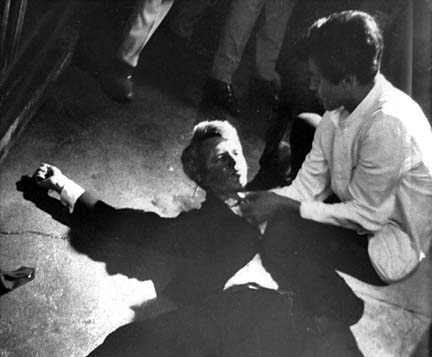
Screenwriter Finds Evidence Implicating 3 CIA Agents In RFK Assassination…

Saturday, November 18, 2006


The Outsmarting of Karl Rove
by Ralph Nader
Howard Dean Defends 50-State Strategy

By MATT GOURAS


Democratic chairman Howard Dean on Friday took a swipe at Washington critics who questioned his strategy of spending money in all 50 states, dismissing them as the "old Democratic Party."

Basking in the afterglow of last week's election victories, Dean told the state party chairmen who were among the biggest beneficiaries of his strategy that it was an approach marked by Democratic wins at all levels of government.

"It was a great win for what I call the new Democratic Party," Dean said in a speech to the Association of State Democratic Chairs. "This is the new Democratic Party. The old Democratic Party is back there in Washington, sometimes they still complain a little bit."

In recent days, political strategist James Carville, best known for his work on Bill Clinton's campaign in 1992, has assailed Dean, saying he left too much money in the bank that could have been used to seize an even larger Democratic majority in Congress.

In one interview, Carville called Dean's errors "Rumsfeldian," a reference to the Defense secretary. In the past, Rumsfeld has railed about "Old Europe" and its reticence in the leadup to the Iraq war.

"The people who complain always get the headlines," Dean said, adding there are other high-profile Democrats who support his initiative. "But the fact is that this strategy not only works, it works in states Democrats have given up on for 30 years.

"We cannot give up on anybody."

The Association of State Democratic Chairs, gathering at this ski resort getaway, adopted a resolution voicing strong support for Dean, who turned 58 on Friday. The resolution said the state chairmen "honor and thank Governor Dean for his tireless commitment to state Democratic Parties and the '50-state strategy' ... and for never retreating from what was right for every Democrat in every state."

Not only did Democrats reclaim the House and Senate, they increased their control of governorships and legislatures. In January, Democrats will have 28 statehouses to 22 for Republicans. The breakdown of state legislatures are 24 with Democrats in full control, 16 Republican, nine split and one nonpartisan.

Dean said the victory included Republican strongholds that Democratic strategists wrote off. Even where they lost, he argued, Democrats made their best showing in years because of the beefed up state organizations.

"That is what the 50-state strategy is about," Dean said.

State party chairmen who receive their checks from the Democratic National Committee clearly took Dean's side.

"I don't think Mr. Carville knows what he's talking about," said Richard Stallings, the Idaho party chairman. "Democrats haven't been winning on the kind of stuff Carville is talking about. The 50-state strategy is the future."

The state chairmen and vice chairmen were key to Dean's successful campaign to become national chairman in 2005, giving him the votes he needed to trump critics from inside the Beltway, where he is not a favorite of the party's established powerbrokers.

The strategy worked, the state chairmen said, who hailed Democrats' victories not only in Congress, but in state legislatures and all the way down to county commissions.

"So when the James Carvilles of the world question the money given to state parties, I have to wonder why," said Mike Gierau, the Wyoming Democratic Party Chairman.

Dean was undeterred by the Washington criticism.

"We are going to do the 50-state strategy for the next 150 years so we can be the dominant party power in this country again," he said. "You can't be the powerful party in this country who controls the government unless you are willing to let the people control you. And the only way you can do that is ask everybody for their vote, understand everybody is our boss even if they vote for you or not."
Six Phony Election Spins
by Katrina Vanden Heuvel

A week after the election, let me challenge some of the mainstream pundits, the conventional wisdom, political analysis or, rather, blather that's been forming. Let me separate fact from spin.

Spin #1: "This election was a victory for centrists."

That's way too simplistic and overlooks the fact that 100 or more candidates ran aggressively on populist economic issues – against unregulated free trade, offshoring of US jobs, against special interests and corporate excesses. Sure, a few winning democrats offered conservative views on guns and abortion. But virtually all ran as "pocketbook populists." The so-called Blue Dog Caucus may have expanded – but the progressive caucus did too. And it remains the larger – in fact, it will be the largest – and most diverse group in house – at 71 members. Also significant, at least ten progressive caucus members will chair house committees – including stalwarts like John Conyers and George Miller. And some 35 will become subcommittee chairs. New members like John Hall of New York, Bruce Braley in Iowa, Carol Shea-Porter and Paul Hodes in New Hampshire, Keith Ellison in Minnesota all ran on platforms to bring troops home, promote economic fairness, make elections more honest and government more ethical and promote energy independence.

Spin # 2: "Democrats have mandate – for bipartisanship – not change."

Enough with bipartisanship! It's too bad that partisanship has become associated with cable show food fights. These are times when principled partisanship is needed – as we confront some real and substantive differences--from economic vision (here we're going to have to really challenge the Wall Street wing of Democratic Party too). But already we see the breakdown of bipartisanship on Bush's renomination of six extremist judges for the federal appeals court; on Medicare reform; on the White House's efforts to push John Bolton back into the United Nations; on attempts to push passage of illegal spying on Americans. Is Bush going to sign a federal minimum wage increase and an effective prescription drug benefit under Medicare? If so, as one commentator put it, "then we can all sing bipartisan kumbaya."

Spin # 3: "Congressional hearings designed to restore oversight and accountability are obstructionist, petty, partisan and a waste of time."

For six years, Congress's oversight function has been corroded and atrophied in a one-party Republican Congress. A vigorous examination of the administration's misconduct is not only necessary to restore checks and balances and our Constitutional system, but it is the politically necessary response to voters' overwhelming rejection of the current Congress's failure to assert itself in this area.

Hearings – whether into war profiteering, oil industry influence, excessive CEO compensation, expanding health coverage, the plight of Iraqi vets, or executive branch misconduct – are vital, not only for oversight, but to bring attention to ideas long missing in our national debate, and to lay the ground for more far-reaching legislation. If designed strategically, they will also help change our national conversation over the next two years. And oversight should not be a Republican or Democratic issue; it is for members of the Constitutionalist party – those true patriots who support the rule of law.

Spin # 4: "This was the end of Republican/Bush era – not the end of the conservative era."

A lot of GOP pols and pundits are arguing that this election was a repudiation of the current Republican party – not of conservatives or their movement. But this election marked the end of a conservative era that began in 1980 . The question now is: What comes next? Democrats will need to be bolder, less risk-averse, and speak to people in ways that are relevant to their lives.

(Some of that may mean redefining centrism so that it is not the centrism of Beltway pollsters and pundits. Americans, after all, talk about wanting to be governed from the center – but it's a different center – one that deals with issues that are at the center of their lives. One that seeks a politics that speaks to and includes affordable childcare and health care, quality public education, retirement security, a living wage, environmental protection, clean elections and a principled – not a messianic – foreign policy.)

Conservatism today stands for what? Certainly not the four pillars it used to stand on: less government; a strong defense; lower taxes and family values. Instead, we've had a crude and reckless foreign policy, an agenda of tax cutting for the richest among us, small government has sunk into an orgy of looting the Treasury by corporate cronies, and alliances with religious right have morphed into fanatical attacks on science and education and stem cell research.

Spin # 5: "Progressive bloggers are pushing the Democratic Party too far to the left."

I don't get it. If a large majority of country opposes war, isn't it the centrist MSM types who are out of step with the mainstream of this country? And in more important ways, blogs are democratizing the public square – bringing in those who've been kept outside the political process for too long and challenging the old establishment matrix of pollsters and pundits.

Spin # 6: "The election system worked surprisingly well this time around."

Much of the mainstream media in a semi-instant analysis proclaimed that the electoral system worked well this time. It's true we didn't see Florida 2000 or even Ohio 2004. But it's just wrong to suggest the problems voters encountered on Election Day weren't serious. There were problems that led to thousands of eligible Americans being denied the opportunity to cast votes. We need real, meaningful election reforms – from fixing flawed voting machines to districts that are rigged to be uncompetitive, to ending a system in which partisan secretaries of state decide who can vote and which votes will be counted to abolishing modern day Jim Crow laws and tactics that suppress the vote. Let's do some democracy promotion at home!

This is a moment to celebrate. It's the beginning of the beginning. A chance to reopen our political space and end the assault on our constitutional design. It's a time to loosen the shackles on our political imagination – and work with determined idealism and grounded realism. It's a time to build, or rebuild, a stronger and independent progressive movement in states and communities across this country. It's a time to strengthen capacity, hone strategy and craft ideas.

I'm a great believer in what Studs Terkel said not long ago: "action engenders hope." These are times for coordinated action and thinking – done with passion, moxie, savvy. And for an insider-outsider politics that supports political leaders at all levels who commit to a politics of principle and conviction – not one of contributions and connections.


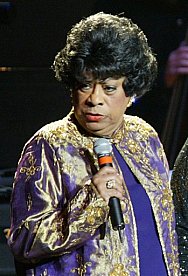
1950s R&B Star Ruth Brown Dies at Age 78
Ruth Brown sings during the "Salute to the Blues" concert at Radio City Music Hall, in this Feb. 7, 2003 file photo, in New York. ...
Beltway attacks on Nancy Pelosi
by Glenn Greenwald

The mindless group-think driving the media's caricatures of Nancy Pelosi is truly astounding to behold, even considering the source. She's not even Speaker yet, and they've already pronounced her to be a bitchy, vindictive shrew incapable of leading because she's consumed by petty personal bickering rather than serious and substantive considerations. And all of this is based on nothing.

Unsurprisingly, all of this has been concocted by the herd of all-knowing Beltway analysts who fancy themselves to be such high-minded warriors against conventional wisdom even though they are its most obedient vessels.

Over at New Republic's The Plank, we learn that the election of Steny Hoyer as Majority Leader "is a real embarassment (sic) for Nancy Pelosi" and that to have any chance to "move past" this towering defeat she must "resist her tendency to seek payback against apostates" (Michael Crowley); "Pelosi looks pretty bad right now" (Jason Zengerle); and, in short, "this was a disaster for Pelosi all the way around" (Christopher Orr). And oh - the great and powerful Tom "Hammer" Delay (who pioneered the art of punishing apostates) would never have allowed something like this to happen.

Their overseer, Marty Peretz, surveys his decades-deep familiarity with American politicians and decides that Pelosi reminds him of . . . . . of all people . . . . Bella Abzug. After he notes the many important and serious differences between the two -- "Pelosi is rather svelte, which Bella was not. Pelosi also doesn't wear a big-brimmed hat" -- he says that neither of these women can "discern between a political difference and a personal war. So if it was the former, it quickly also became the latter." Says Peretz of Pelosi: she "cannot separate personal from political differences. And where Pelosi's vanity goes, there, apparently, the House Democrats will follow."

At Slate, Timothy Noah has a column entitled "Dump Pelosi," in which he generously decrees: "Let Pelosi remain speaker for now. But let her know that, before the new Congress even begins, she has placed herself on probation." Noah warns her: "One more strike—even a minor misstep—and House Democrats will demonstrate that they, unlike Speaker-elect Pelosi and President Bush, know how to correct their mistakes."

This is everywhere, permeating all aspects of the media. Digby describes a particularly giggly version of it on MSNBC last night. These sweeping condemnations of Pelosi all arise out of two -- and only two -- incidents: (1) her support for Jack Murtha over Steny Hoyer as Majority Leader and (2) her opposition to Jane Harman becoming Chair of the House Intelligence Committee.

It is painfully obvious that Pelosi supported Murtha for one very simple and extremely common reason -- because unlike Hoyer, with whom she has a tense and uncomfortable working relationship and with whom she has worked at cross-purposes in the past, Murtha is her ally and supporter. Murtha held a blogger conference call a couple of days ago and in response to every question, he repeatedly emphasized that his intention was to concentrate on Iraq and that in all other areas, he would "do what Nancy wants." He's a Pelosi loyalist and ally and so she supported him for that job over someone who isn't.

Is that supposed to be unusual? That's how all of Washington works. It's how the world works. Here is what Peggy Noonan said in her column today about how the Bush administration operates and why Mel Martinez was made RNC Chair rather than Michael Steele:


I am taken aback this week at the level of disenchantment with and dislike of the president and his men--not among Democrats, but among Republicans. On the Hill they no longer see the White House as talented and formidable. They see it as shuttered and second-rate. . . . .

There is increased criticism too of the habit of high White House staffers to muscle critics, silence dissent, force obedience.

It is assumed by everyone, and accepted as truth that hardly needs expression, that the brilliant and independent Michael Steele was not chosen as head of the RNC for the simple reason that he doesn't look like someone who'd simply take orders. Mel Martinez was chosen for the reason that he will. I heard talk of what is called "the list"--the lengthening White House list of those who are to be treated as enemies.


The Bush administration has spent six years completely obsessed with personal loyalty to the President and intolerant of the slightest independence. The entire Congress was kept strictly in line for the last five years. Every official who showed the slightest independence was replaced by obedient Bush loyalists. Yet Pelosi does nothing other than support an ally rather than an opponent for the position immediately underneath her, and that makes her some out-of-control egomaniac consumed by personal vanity and emotional impulses.

And that's to say nothing of the fact that the Hoyer-Murtha race is being depicted as some sort of sign of hateful Democratic in-fighting that shows Pelosi has lost control, even though Republicans are mauling each other for every single House leadership position, all of which are hotly contested. Trent Lott beat Lamar Alexander by a vote of 25-24 in the Senate for the position of Minority Whip. There's nothing wrong with various factions competing for leadership positions. That's called an "election," and only those to whom Eric Alterman refers as the "smart boys" at TNR and Slate would view a simple election for House Majority Leader as some apocalyptic sign that Democrats are lame, idiotic and hopelessly divided. I'm sure Mark Halperin agrees with all of their attacks.

And then there is Pelosi's opposition to Jane Harman. It's now an article of Beltway faith that Pelosi opposes Harman because of what is being referred to as a personal "cat fight" between them, arising out of purely personal issues (like they both wore the same dress to a Capitol Hill event and Pelosi has never forgiven Harman). At Slate, Noah claims that the reasons for "Pelosi's animus are cloudy and in all likelihood personal."

I'd like to see proof that Pelosi's opposition to Harman is purely or even principally personal. I keep hearing this from them, but what is it based on? Personally, I think Harman -- who was one of the most aggressive defenders of the President's warrantless eavesdropping program ("both legal and necessary," she repeatedly chimed) and is currently under investigation for her work on behalf of AIPAC -- would make a horrendous Chair (although Alcee Hastings is one of the few House members who might be less desirable). She has been far too sympathetic to the administration's excesses and far too eager to serve as a Democratic shield publicly defending the President.

How do these all-knowing analysts know that Pelosi's opposition to Harman isn't based on these obvious and compelling substantive grounds, as opposed to the bitchy personal "cat fights" they allegedly have had? They don't know, but they keep repeating it anyway, because it seems to fit comfortably with a picture they are very eager to paint.

In fact, Noah himself references a column by what he calls "his friend Ruth Marcus, an op-ed columnist at the Washington Post,"which claims that Pelosi thinks that Harman has been "insufficiently partisan on the committee." That's the opposite of the claim being advanced everywhere that Pelosi opposes Harman for purely personal, substance-free reasons. They just make things up in order to bolster their group-driven collective imagination, and then present their group gossip as authoritative and established insider wisdom.

And, even if Pelosi's opposition to Harman were due more to personal animosity than it is to substantive disagreements, is there some suggestion that this is an unusual attribute among political leaders -- or human beings anywhere? Washington is full of all sorts of personal conflicts and animosity that drive personnel decisions of every type, yet somehow and for some reason, in Pelosi it's depicted as some unique and glaring flaw. It's worth wondering why that is.

Americans just elected new leadership quite deliberately. They are obviously fine with Nancy Pelosi. Republicans tried to make the election be about her -- constantly reminding everyone that a vote for Democrats would mean installing super-liberal Nancy Pelosi and her San Francisco values in power -- and the Democrats won. So voters have no problem with Pelosi. They want Congressional Democrats to take the lead in policy and governance because the Republicans have failed so miserably. I have no idea whether Pelosi will be a good Speaker, but I'm going to withhold judgment until she actually at least starts, and Americans are obviously doing that as well.

Yet the Beltway media mavens know better, and so they are already out in force attacking Pelosi's character with petty and baseless chattering. This country has extremely serious issues facing it, and yet these self-styled "serious" journalists are already trying to cripple Pelosi's ability to do anything before she has even begun, all based on giggly chit-chat and gossipy garbage that has no legitimacy other than the fact that they all repeat it in unison on television and in print.

It's what these pundits and journalists do. They have pre-conceived, vapid notions about everything and everyone -- all driven by deep self-love for their own superior wisdom -- and they distort reality and crowd out sober analysis of everything that matters. Nancy Pelosi, and really everyone, would be well-advised not to listen to them and, above all, never adopt as a goal trying to please or satisfy them. They are frivolous and out of touch with everything that matters and should be treated as such.

Friday, November 17, 2006

Fast times at DC High:

Man are these catty little MSNBC snots enjoying their full-on Demo bitch fest. They are partying like it's 1999. Norah O'Donnell, Lawrence O'Donnell, Mary Ann Akers and some other person I don't know have just spent half an hour discussing the fact that Nancy Pelosi ruined her own honeymoon and now it is really questionable whether she can lead...

Meanwhile, the dirty netroots and Howard Dean must have done something wrong because James Carville is hanging out all the Democratic dirty laundry (while his wife cackles with glee, no doubt) and he wouldn't do that unless there was something to it.

After a thorough discussion of how hapless the Democratic nerds have already proven to be, Mary Ann Akers whispers that reporters all over town are "loving" this story. It's so much fun! All the kidz squealed like schoolgirls at prospect of the merciless going-over they are preparing to give these totalbigfatlosers. ("We're so not being mean or anything cuz they like totally deserve it cuz they just don't get it, ok?")

The spite girls are back in town. It isn't so much a matter of substance. You can argue that talking about the majority leader race is worthwhile and that it says something about Pelosi's leadership style. The Carville sideswipe at Dean is interesting. That's not the problem. It's that the patented 90's style smug, juvenile, derisive Kewl Kidz tone is once again ooozing through everything they say. (I could have sworn I heard the "Friends" theme song in the background.)

It's as if all these unpleasant events of the last six years never happened and we are back in the days of endless cable bitch-fests filled with sniggering about unauthorized blow jobs and earth tones and "grown-ups" who eat PB&J's and travel with their favorite pillies.

I knew it would happen in one form or another. (We caught a glimpse of it with the John Kerry apology treatment.) The DC press corps hates having to criticize Republicans. Republicans make them feel all icky and call them liberals (which they so, like, aren't!) I confess, however, that I'm a little bit awed by how smoothly they have transitioned back into their assigned roles. I thought there might be a moment or two of cognitive dissonance as they went from grim and serious reports about terrorism and war to shallow personality politics and tabloid character assassination. I assumed they would at least wait until the presidential campaign took off to contrast the manly Republican Alpha with the loser Omega Dem, but I guess I didn't realize how much they've missed their fast times at DC High.
MORE

by Peter Daou

Thursday, November 16, 2006


Woof! Who Really Won the Hoyer/Murtha Showdown
Remember the Blue Dog Democrats? In the new Congress, you’ll be hearing from them a lot.
by James Ridgeway
Watershed
William Greider writes that Democrats in Congress can now return to a reality-based politics that nourishes rather than destroys.
Murtha Loses... But It's Still a Victory for Pelosi
by Arianna Huffington

The votes are in and Steny Hoyer is the new House majority leaders, winning out over Jack Murtha 149-86.

For all the reasons I've made abundantly clear, I would've loved to see Murtha as Majority Leader. But he remains the Democratic leader on Iraq -- and we need his unwavering voice on the war out there more than ever, as the debate on Iraq threatens to enter the twilight zone.


Barely a week after the American people sent the unequivocal message that they want to bring our troops home, we have Gen. Abizaid telling the Senate Armed Forces Committee that he was "very encouraged" by his recent trip to Iraq, that "significant progress is being made" in turning over security to "capable Iraqi forces," and that "levels of sectarian violence are down in Baghdad." Tell that to the 150 Iraqis kidnapped on Tuesday or the dozens killed in the last few days.

What's more, we even have the New York Times -- not George Bush or Dick Cheney, mind you, but the editorial page of the Times -- arguing for more troops to be sent "in one last push to stabilize Baghdad." First McCain, now the Times -- the peace through escalation meme is catching on.

So even though Murtha won't be Majority Leader, he is still the one Democrats need to follow on Iraq -- the clearest, most passionate voice breaking through the cacophony trying to give new life to staying the course or, even worse, upping the ante in Iraq.

And don't shed any tears for Speaker-elect Nancy Pelosi. Even though her guy lost, this was still a big win for her. A victory for taking a stand -- and for her leadership. Because that's what real leaders do, they take stands. They listen to their hearts and follow their gut. If you only jump into the fights you're sure you can win -- notches in the W column that will look good on your political resume -- you're a hack, not someone who can move the party and the country forward. It's not about trying to have a spotless record; it's about knowing which battles are worth fighting, whatever the outcome.

It bodes well for Pelosi that was willing to spend her political capital right off the bat -- especially on the issue that will define her time at the helm. Far too many modern politicians save their political capital until it's lost all its value.

First Muslim In Congress Snubs Bush, Meets With Big Labor Instead
By Matt Corley

Keith Ellison, the first Muslim ever elected to Congress, hasn't even taken office yet, but he already appears to be charting his own route in Congress. The Associated Press reports that Ellison skipped a swanky private White House reception for other freshman Congressman hosted by President Bush -- and went to a reception for the AFL-CIO instead. "It wasn't even a close call," Ellison says. "Maybe one day I'll get to meet the president. He's the president, and I respect him in his role as the president, but I have exceedingly sharp differences with him on a policy level." Somehow we doubt that Ellison's complete lack of interest in hobnobbing with Bush will make him any more popular with his many conservative critics.

Blog Archive