Senators tell Rice: The president has lost us
by Tim Grieve
Ohio Sen. George Voinovich writes letters to the families of fallen U.S. soldiers. Until now, he's said in those letters that the sacrifices Americans troops are making in Iraq are every bit the equal of those U.S. soldiers made in World War II. But Voinovich told Secretary of State Condoleezza Rice this afternoon that he's going to have to change his letter now. "I've gone along with the president on this, and I've bought into his dream," Voinovich said, his voice choking with emotion. "At this stage of the game, I don't think it's going to happen."
The Ohio Republican's delivery was more emotional than some of his colleagues', but the sentiment he expressed this afternoon was pretty much the same as the one Rice heard from most members of the Senate Foreign Relations Committee: The president has lost the American people and their representatives, and the new "way forward" he put forth last night isn't enough to win them over again.
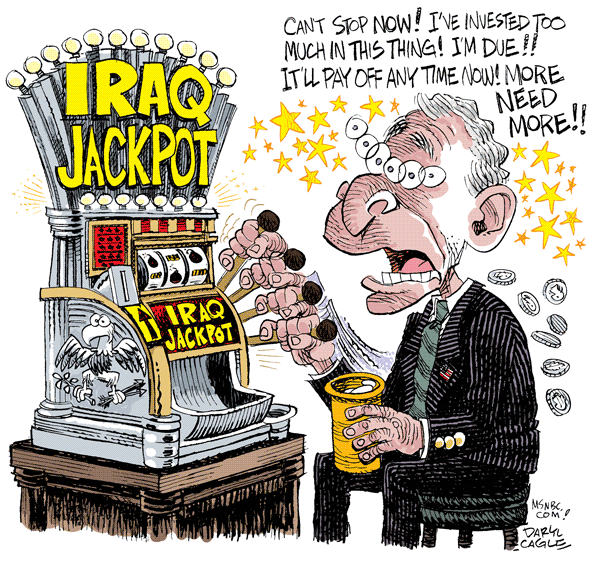
Barack Obama told Rice that the Bush administration "took a gamble" in Iraq, staking "American prestige and our national security on the premise that it could go in, overthrow Saddam Hussein and rebuild a functioning democracy. And so far . . . it appears to have failed. And essentially, the administration has repeatedly said, 'We're doubling down, we're going to keep on going. Maybe we lost that bet, but we're going to put a little more money in.'"
Like John Kerry and Norm Coleman before him, Obama tried, unsuccessfully, to get Rice to describe what would happen if the Maliki government doesn't live up to its promises this time around: "Are there any circumstances that the president or you are willing to share in which we would say to the Iraqis, 'We are no longer maintaining American combat troops in Iraq?' Are they any circumstances you can articulate in which you would say to the Maliki government, 'Enough is enough?'"
Rice said she was "not going to speculate" and that Bush has already made it clear that Americans' patience isn't unlimited.
Walking out of the hearing, Obama acknowledged that there was probably nothing Rice could have said that would have satisfied him so long as it involved sending 21,000 more U.S. troops to Iraq. Waiting for a train back to the Capitol, he told his staff that he was happy that today's hearing had shown "bipartisan" opposition to the president's new plan. He was certainly right about that. Some highlights from the day's session:
Sen. John Sununu: The New Hampshire Republican warned Rice that "if we don't see more specifics and a time frame" for progress in Iraq, "then Congress is probably going to step into the void and set a time frame." He said he would prefer to have the administration, not Congress, set a more specific time frame. Rice said she'd get back to him with a clearer sense of when the Iraqis thought they could accomplish the things they're supposed to be accomplishing, but she didn't say anything about setting hard-and-fast deadlines for when the United States expected Iraq to do anything. Indeed, at one point during today's proceedings, she seemed to soften on the whole idea of benchmarks, saying that legislatures in the United States don't always meet the deadlines they're supposed to meet for getting things done.
Sen. Russ Feingold: The Wisconsin Democrat said that that it is time for Congress to use "the power of the purse" to cut off funding for the war -- not just for the escalation, but for the entire war. "By setting an end date for funding for the war, we can give the president the time needed to redeploy troops safely from Iraq." Feingold's words drew a rare round of applause from some of those gathered to watch the hearing.
Sen. Bill Nelson: The Florida Democrat said that although he has supported Rice and the Bush administration on the war in the past, he can do so no longer. "I have not been told the truth," he said. "I have not been told the truth over and over again by administration witnesses. And the American people have not been told the truth."
Sen. Barbara Boxer: The California Democrat mocked Rice for telling the committee in 2005 that she had "no doubt" that Iraqi forces would be talking control of their own security and that American soldiers would be coming home in a "reasonable time frame." Boxer told Rice: "From where I sit, Madame Secretary, you are not listening to the American people. You are not listening to the military. You are not listening to the bipartisan voices of Congress; you are not listening to the Iraq Study Group."
Sen. Chuck Hagel: The Nebraska Republican said the president has "set in motion" a "very, very dangerous" series of events. "I think this speech given last night by this president represents the most dangerous foreign policy blunder in this country since Vietnam," he said. When Hagel referred to the president's plan for an "escalation," Rice said that she and the president preferred the term "augmentation," and that it was important for everyone to have the right "image" of what's actually happening on the ground in Iraq. When Hagel said he had a pretty good "image" of the situation already -- "Iraqis are killing Iraqis ... we're in a civil war" -- Rice responded lamely: "Not all of Baghdad has fallen into a civil war."
Thursday, January 11, 2007


A Surge in American Forces is Unacceptable
by Rep. John Murtha
A year ago, I said this was a failed policy wrapped in an illusion. The President has finally acknowledged this.
Five months ago, we put an additional 10,000 troops in Baghdad. Attacks increased and a record number of Americans and Iraqis were killed. I see no difference between this and the President's plan to "stay the course."
I am particularly disappointed that there are no credible benchmarks and no way to measure the military and economic progress of this operation. There is no incentive for the Iraqis to take over.
All of us want stability in the Middle East, and Iraq is an important element in achieving that stability. But the military and their families deserve an achievable mission. It is unacceptable to me that we are sending troops back to Iraq who have not completed their training cycle and that we are extending troops who are battle-weary from the intensive combat in Iraq.
A year ago, I called for a redeployment of our forces and predicted that this "stay the course" policy would adversely affect our military readiness. The Defense Subcommittee will begin holding extensive hearings on January 17th to determine how we can best restore the readiness and
by Rep. John Murtha
A year ago, I said this was a failed policy wrapped in an illusion. The President has finally acknowledged this.
Five months ago, we put an additional 10,000 troops in Baghdad. Attacks increased and a record number of Americans and Iraqis were killed. I see no difference between this and the President's plan to "stay the course."
I am particularly disappointed that there are no credible benchmarks and no way to measure the military and economic progress of this operation. There is no incentive for the Iraqis to take over.
All of us want stability in the Middle East, and Iraq is an important element in achieving that stability. But the military and their families deserve an achievable mission. It is unacceptable to me that we are sending troops back to Iraq who have not completed their training cycle and that we are extending troops who are battle-weary from the intensive combat in Iraq.
A year ago, I called for a redeployment of our forces and predicted that this "stay the course" policy would adversely affect our military readiness. The Defense Subcommittee will begin holding extensive hearings on January 17th to determine how we can best restore the readiness and
On to Iran?
A deflated commander in chief tries to rally the nation behind one last push in Iraq -- and maybe beyond.
By Walter Shapiro
Jan. 11, 2007 WASHINGTON -- Throughout the long century to come, any future leader contemplating sending American troops into combat should carefully watch a tape of George W. Bush's speech to the nation Wednesday night -- and ponder its underlying lessons. This was Bush deflated, his arrogance temporarily placed in a blind trust, looking grayer than ever with his brow furrowed with lines of worry. How humiliating for Bush to be forced to say with a stony face, "The situation in Iraq is unacceptable to the American people -- and it is unacceptable to me."
This is what happens to a commander in chief when his vision of victory becomes a struggle for survival, when confident talk of a slam dunk on the way in is replaced by a clamor to slam the door on the way out. This is what happens to a president who is losing a war -- and who is reduced to begging for more time, another chance, to set things right.
Little more than a year ago, Bush unveiled what was then billed as his "Strategy for Victory in Iraq." Speaking to the midshipmen at the Naval Academy in late November 2005, the president declared in a confident tone, "Coalition and Iraqi security forces are on the offensive against the enemy, cleaning out areas controlled by the terrorists and Saddam loyalists, leaving Iraqi forces to hold territory taken from the enemy, and following up with targeted reconstruction to help Iraqis rebuild their lives."
As a portrait of reality, that ranks up there with "Brownie, you're doing a heck of a job." Suffice it to say that a limited number -- a very limited number -- of Iraqis have been able to rebuild their lives. Bush himself said Wednesday night with uncharacteristic albeit belated honesty, "The violence in Iraq, particularly in Baghdad, overwhelmed the political gains the Iraqis had made."
Anytime a president commands network prime time for a White House address, it is a political moment, even if Bush himself is immune from the direct wrath of the voters. Yet it is misleading to look at the strategy behind the Iraq speech in traditional Republicans-versus-Democrats terms. Bush was speaking to a far narrower audience than the nation at large. The situation in Iraq is too dire for the president to dream of converting Democrats or even independent voters to the cause of staying the course. Bush was playing to the only constituency he has left -- the Republican base.
Even at a time when GOP incumbents who face difficult 2008 reelection fights have become militant critics of escalation (Sens. Gordon Smith, of Oregon, and Norm Coleman, of Minnesota, are two), Bush still commands the personal loyalty of much of his party despite the deepening Mesopotamian morass. All the major presidential contenders (Rudy Giuliani, Mitt Romney and, of course, John McCain) bowed to heavy pressure from the White House not to dissent too audibly in their public comments about Bush's speech and plan for a troop surge.
The White House knows the limitations of the powers of Congress in wartime, even with legislators as aroused as the incoming Democrats. Virtually all congressional attempts to force Bush to change his strategy in Iraq would be vulnerable to a presidential veto, which could be overridden only by a two-thirds vote of both houses of Congress. As long as the president holds on to his Republican base in Congress -- plus Joe Lieberman, who was pointedly singled out in the speech -- he can continue to run the war his way.
But it is clear that Bush understands at this stage in the war that even loyal Republican voters need convincing. A revealing moment in the speech came when Bush stepped out of character and tried to address the inherent skepticism of his audience: "Many listening tonight will ask why this effort will succeed when previous operations to secure Baghdad did not." The president's answers were weak, such as when he claimed, "This time, we will have the force levels we need to hold the areas that have been cleared." Few military experts -- outside of perhaps the geopolitical strategists at Fox News and neoconservative think tanks -- believe that Bush's plan to deploy 21,000 more soldiers in Baghdad and Anbar province will do the job. Even Bush sounded tentative on this score when he began a sentence, "Even if our new strategy works exactly as planned..."
Ever since Bush denounced the theretofore unknown "Axis of Evil" in his 2002 State of the Union Address, at a moment when the nation was still fixated on the horrors of Sept. 11, it has been instructive to listen for new rhetorical gambits in major presidential speeches. That is why it is possible that the most fateful words that Bush uttered from the White House library on Wednesday night were these: "Iran is providing material support for attacks on American troops. We will disrupt the attacks on our forces. We will interrupt the flow of support from Iran and Syria."
Even though the Democrats have won the rhetorical war in labeling the Bush war plan as escalation, 21,000 additional troops is pretty small potatoes by the standards of prior wars such as Vietnam. But expanding the battlefield to the borders of Iran and Syria -- if that was indeed what Bush was suggesting -- now that would qualify as escalation, as even Henry Kissinger might admit.
Bush may well have bought himself a little more room for maneuver in Iraq with his attempt at donning sackcloth and ashes. But trapped in an abysmal situation largely of his own making, it is worth wondering what Bush's own secret exit plan might be. Is his latest speech -- and the troop surge -- a last show of muscular resolve before Bush bows to political reality and the willful ineptitude of the Maliki government and reluctantly sets a timetable for withdrawal? Or will Bush's last-desperation gambit be a wider war that touches Iran and Syria? Either way, it is a cautionary reminder of what happens when you go to war with the president you've got rather than the president you'd like to have.
A deflated commander in chief tries to rally the nation behind one last push in Iraq -- and maybe beyond.
By Walter Shapiro
Jan. 11, 2007 WASHINGTON -- Throughout the long century to come, any future leader contemplating sending American troops into combat should carefully watch a tape of George W. Bush's speech to the nation Wednesday night -- and ponder its underlying lessons. This was Bush deflated, his arrogance temporarily placed in a blind trust, looking grayer than ever with his brow furrowed with lines of worry. How humiliating for Bush to be forced to say with a stony face, "The situation in Iraq is unacceptable to the American people -- and it is unacceptable to me."
This is what happens to a commander in chief when his vision of victory becomes a struggle for survival, when confident talk of a slam dunk on the way in is replaced by a clamor to slam the door on the way out. This is what happens to a president who is losing a war -- and who is reduced to begging for more time, another chance, to set things right.
Little more than a year ago, Bush unveiled what was then billed as his "Strategy for Victory in Iraq." Speaking to the midshipmen at the Naval Academy in late November 2005, the president declared in a confident tone, "Coalition and Iraqi security forces are on the offensive against the enemy, cleaning out areas controlled by the terrorists and Saddam loyalists, leaving Iraqi forces to hold territory taken from the enemy, and following up with targeted reconstruction to help Iraqis rebuild their lives."
As a portrait of reality, that ranks up there with "Brownie, you're doing a heck of a job." Suffice it to say that a limited number -- a very limited number -- of Iraqis have been able to rebuild their lives. Bush himself said Wednesday night with uncharacteristic albeit belated honesty, "The violence in Iraq, particularly in Baghdad, overwhelmed the political gains the Iraqis had made."
Anytime a president commands network prime time for a White House address, it is a political moment, even if Bush himself is immune from the direct wrath of the voters. Yet it is misleading to look at the strategy behind the Iraq speech in traditional Republicans-versus-Democrats terms. Bush was speaking to a far narrower audience than the nation at large. The situation in Iraq is too dire for the president to dream of converting Democrats or even independent voters to the cause of staying the course. Bush was playing to the only constituency he has left -- the Republican base.
Even at a time when GOP incumbents who face difficult 2008 reelection fights have become militant critics of escalation (Sens. Gordon Smith, of Oregon, and Norm Coleman, of Minnesota, are two), Bush still commands the personal loyalty of much of his party despite the deepening Mesopotamian morass. All the major presidential contenders (Rudy Giuliani, Mitt Romney and, of course, John McCain) bowed to heavy pressure from the White House not to dissent too audibly in their public comments about Bush's speech and plan for a troop surge.
The White House knows the limitations of the powers of Congress in wartime, even with legislators as aroused as the incoming Democrats. Virtually all congressional attempts to force Bush to change his strategy in Iraq would be vulnerable to a presidential veto, which could be overridden only by a two-thirds vote of both houses of Congress. As long as the president holds on to his Republican base in Congress -- plus Joe Lieberman, who was pointedly singled out in the speech -- he can continue to run the war his way.
But it is clear that Bush understands at this stage in the war that even loyal Republican voters need convincing. A revealing moment in the speech came when Bush stepped out of character and tried to address the inherent skepticism of his audience: "Many listening tonight will ask why this effort will succeed when previous operations to secure Baghdad did not." The president's answers were weak, such as when he claimed, "This time, we will have the force levels we need to hold the areas that have been cleared." Few military experts -- outside of perhaps the geopolitical strategists at Fox News and neoconservative think tanks -- believe that Bush's plan to deploy 21,000 more soldiers in Baghdad and Anbar province will do the job. Even Bush sounded tentative on this score when he began a sentence, "Even if our new strategy works exactly as planned..."
Ever since Bush denounced the theretofore unknown "Axis of Evil" in his 2002 State of the Union Address, at a moment when the nation was still fixated on the horrors of Sept. 11, it has been instructive to listen for new rhetorical gambits in major presidential speeches. That is why it is possible that the most fateful words that Bush uttered from the White House library on Wednesday night were these: "Iran is providing material support for attacks on American troops. We will disrupt the attacks on our forces. We will interrupt the flow of support from Iran and Syria."
Even though the Democrats have won the rhetorical war in labeling the Bush war plan as escalation, 21,000 additional troops is pretty small potatoes by the standards of prior wars such as Vietnam. But expanding the battlefield to the borders of Iran and Syria -- if that was indeed what Bush was suggesting -- now that would qualify as escalation, as even Henry Kissinger might admit.
Bush may well have bought himself a little more room for maneuver in Iraq with his attempt at donning sackcloth and ashes. But trapped in an abysmal situation largely of his own making, it is worth wondering what Bush's own secret exit plan might be. Is his latest speech -- and the troop surge -- a last show of muscular resolve before Bush bows to political reality and the willful ineptitude of the Maliki government and reluctantly sets a timetable for withdrawal? Or will Bush's last-desperation gambit be a wider war that touches Iran and Syria? Either way, it is a cautionary reminder of what happens when you go to war with the president you've got rather than the president you'd like to have.
The President's New Way Forward Plan: Shocking in its Banality
by Arianna Huffington
So there you have it. The New Way Forward. The promise of great new things followed up by the delivery of more of the same failed thinking and policies.
"The new strategy I outline tonight," said the president, "will change America's course in Iraq, and help us succeed in the fight against terror."
Unfortunately the grandeur of that promise was contrasted by the shocking banality of what is actually being proposed.
Here are the "Six Fundamental Elements" the president's new strategy is "rooted in" (as laid out in a helpful little fact sheet the White House released to coincide with the speech): 1) Let the Iraqis lead; 2) Help Iraqis protect the population; 3) Isolate extremists; 4) Create space for political progress; 5) Diversify political and economic efforts; and 6) Situate the strategy in a regional approach.
Here are my Two Fundamental Reactions: 1) Sure, of course; these make total sense. But aren't these the very things we've already being doing? What exactly is new about this strategy? How is this attempt to help Iraqis protect the population different than all the other attempts to help Iraqis protect the population? Haven't we been trying to isolate extremists and create a "space for political progress" all along? (After we captured Saddam and stopped looking for WMD, that is.) Is the difference that this time we really mean it?
2) Wow, those must be 20,000 pretty awesome troops the president is sending in, if they are going to successfully do all that when the 145,000 troops we have now (or the 160,000 we had a year ago) weren't been able to.
Here are some of the presidential concepts that filled me with dreadful feelings of déjà vu:
"Agree that helping Iraqis to provide population security is necessary to enable accelerated transition and political progress."
"Strengthen the rule of law and combat corruption."
"Encourage Arab state support to Government of Iraq."
"Support political moderates so they can take on the extremists."
All worthy goals but, let's get real Mr. President, these aren't exactly the promised silver bullets that "will change America's course in Iraq."
But reality-based thinking is clearly an anathema to Bush, who continues to insist, with all his might, that Iraq is some kind of war-on-terror-defining Shootout at the Islamist Corral, pitching the white hats of freedom against the black hats of terror. "The war on terror cannot be won if we fail in Iraq," warns the White House fact sheet, as if that discredited line of reasoning is, in fact, a fact. "Our enemies throughout the Middle East are trying to defeat us in Iraq." I guess the White House never got the memo that the fight in Iraq is now more about Shiites and Sunnis trying to resolve centuries-old grievances, than it is about tracking down terrorists. Or, more likely, it did get the memo (there's been plenty of them) and decided to ignore it, knowing that "killing the bad guys that want to kill us" is an easier sell than "playing traffic cop in the middle of a civil war." But the American people aren't buying it anymore.
And, no matter how many times the president keeps saying it, we're not buying that we're fighting them over there so we don't have to fight them over here. That, of course, didn't stop the president from trotting out the old flypaper strategy again: "Tonight in Iraq," he said, "the armed Forces of the United States are engaged in a struggle that will determine the direction of the war on terror -- and our safety here at home." (Apparently Bush's addiction to fear-mongering is hard to break. Not even the thumpin' he took in November -- and continues to take in the polls -- is enough to make him go cold turkey.)
Drudge made a lot of the president's admission of mistakes in Iraq -- as if this were major news, which is, no doubt, what the White House wanted. But the president has already admitted mistakes in Iraq. His mistake now is in not changing course (except rhetorically) after the earlier admissions of mistakes. The reason why admitting mistakes is considered a good thing to do is the assumption that you'll stop making them -- or at least stop making the same ones. But Bush is even incompetent at admitting his own incompetence. It's like an alcoholic admitting he's started drinking again, then announcing he plans to get back on the wagon by drinking even more. You should not get credit for admitting mistakes unless the admission is accompanied by an effort to stop making them.
Tonight's speech did give us one new thing: a new definition of victory. According to the president: "Victory will not look like the ones our fathers and grandfathers achieved. There will be no surrender ceremony on the deck of a battleship... A democratic Iraq will not be perfect. But it will be a country that fights terrorists instead of harboring them -- and it will help bring a future of peace and security for our children and grandchildren." So victory will be achieved when Iraq starts fighting terrorists instead of harboring them. Like Pakistan. Or Saudi Arabia.
At the end of the day, victory in Iraq, for the president, is like pornography -- you can't really describe it, but, he assures us, we'll know it when we see it. Or, more accurately, when our children and grandchildren see it. God willing.
by Arianna Huffington
So there you have it. The New Way Forward. The promise of great new things followed up by the delivery of more of the same failed thinking and policies.
"The new strategy I outline tonight," said the president, "will change America's course in Iraq, and help us succeed in the fight against terror."
Unfortunately the grandeur of that promise was contrasted by the shocking banality of what is actually being proposed.
Here are the "Six Fundamental Elements" the president's new strategy is "rooted in" (as laid out in a helpful little fact sheet the White House released to coincide with the speech): 1) Let the Iraqis lead; 2) Help Iraqis protect the population; 3) Isolate extremists; 4) Create space for political progress; 5) Diversify political and economic efforts; and 6) Situate the strategy in a regional approach.
Here are my Two Fundamental Reactions: 1) Sure, of course; these make total sense. But aren't these the very things we've already being doing? What exactly is new about this strategy? How is this attempt to help Iraqis protect the population different than all the other attempts to help Iraqis protect the population? Haven't we been trying to isolate extremists and create a "space for political progress" all along? (After we captured Saddam and stopped looking for WMD, that is.) Is the difference that this time we really mean it?
2) Wow, those must be 20,000 pretty awesome troops the president is sending in, if they are going to successfully do all that when the 145,000 troops we have now (or the 160,000 we had a year ago) weren't been able to.
Here are some of the presidential concepts that filled me with dreadful feelings of déjà vu:
"Agree that helping Iraqis to provide population security is necessary to enable accelerated transition and political progress."
"Strengthen the rule of law and combat corruption."
"Encourage Arab state support to Government of Iraq."
"Support political moderates so they can take on the extremists."
All worthy goals but, let's get real Mr. President, these aren't exactly the promised silver bullets that "will change America's course in Iraq."
But reality-based thinking is clearly an anathema to Bush, who continues to insist, with all his might, that Iraq is some kind of war-on-terror-defining Shootout at the Islamist Corral, pitching the white hats of freedom against the black hats of terror. "The war on terror cannot be won if we fail in Iraq," warns the White House fact sheet, as if that discredited line of reasoning is, in fact, a fact. "Our enemies throughout the Middle East are trying to defeat us in Iraq." I guess the White House never got the memo that the fight in Iraq is now more about Shiites and Sunnis trying to resolve centuries-old grievances, than it is about tracking down terrorists. Or, more likely, it did get the memo (there's been plenty of them) and decided to ignore it, knowing that "killing the bad guys that want to kill us" is an easier sell than "playing traffic cop in the middle of a civil war." But the American people aren't buying it anymore.
And, no matter how many times the president keeps saying it, we're not buying that we're fighting them over there so we don't have to fight them over here. That, of course, didn't stop the president from trotting out the old flypaper strategy again: "Tonight in Iraq," he said, "the armed Forces of the United States are engaged in a struggle that will determine the direction of the war on terror -- and our safety here at home." (Apparently Bush's addiction to fear-mongering is hard to break. Not even the thumpin' he took in November -- and continues to take in the polls -- is enough to make him go cold turkey.)
Drudge made a lot of the president's admission of mistakes in Iraq -- as if this were major news, which is, no doubt, what the White House wanted. But the president has already admitted mistakes in Iraq. His mistake now is in not changing course (except rhetorically) after the earlier admissions of mistakes. The reason why admitting mistakes is considered a good thing to do is the assumption that you'll stop making them -- or at least stop making the same ones. But Bush is even incompetent at admitting his own incompetence. It's like an alcoholic admitting he's started drinking again, then announcing he plans to get back on the wagon by drinking even more. You should not get credit for admitting mistakes unless the admission is accompanied by an effort to stop making them.
Tonight's speech did give us one new thing: a new definition of victory. According to the president: "Victory will not look like the ones our fathers and grandfathers achieved. There will be no surrender ceremony on the deck of a battleship... A democratic Iraq will not be perfect. But it will be a country that fights terrorists instead of harboring them -- and it will help bring a future of peace and security for our children and grandchildren." So victory will be achieved when Iraq starts fighting terrorists instead of harboring them. Like Pakistan. Or Saudi Arabia.
At the end of the day, victory in Iraq, for the president, is like pornography -- you can't really describe it, but, he assures us, we'll know it when we see it. Or, more accurately, when our children and grandchildren see it. God willing.
Wednesday, January 10, 2007
Escalation? It's Not His Decision to Make
by Sen. Edward M. Kennedy
Iraq is George Bush's Vietnam, and we cannot allow history to repeat itself any longer. Our troops deserve better. We must act now.
Today, I introduced legislation to reclaim the people's right to a full voice in the president's plan to send more troops to Iraq. My bill will say that no additional troops can be sent and no additional dollars can be spent on such an escalation unless and until Congress approves the president's plan.
Congress must exert its constitutional authority and demand a vote before any escalation in Iraq. In October 2002, Members of Congress authorized a war against the regime of Saddam Hussein, not to send our troops into a civil war. I voted against that resolution and feel an escalation of this war only compounds the original mistake of going in the first place.
A military escalation in Iraq would not strengthen our national security -- instead it would further weaken it by enabling the Iraqis to avoid taking responsibility for their own future.
More than 3000 American soldiers have died in Iraq and more than 22,000 have been wounded.
Instead of continued mistakes and shoot-from-the-hip policies, it's time to get this right. The President must make clear the mission of our troops and lay out a path to bring them home, and Congress must stop being a rubberstamp for failed policies and stand up and act.
Never before has our system of checks and balances been so important. Join the thousands who have already shown their support by signing our petition:
http://www.tedkennedy.com/ourdecision
I hope you'll take a moment to learn a little more about this legislation and then spread the word. We have posted video of my speech at the National Press Club. I have also posted a diary at DailyKos.com earlier today. That post includes an email sent to TedKennedy.com members.
by Sen. Edward M. Kennedy
Iraq is George Bush's Vietnam, and we cannot allow history to repeat itself any longer. Our troops deserve better. We must act now.
Today, I introduced legislation to reclaim the people's right to a full voice in the president's plan to send more troops to Iraq. My bill will say that no additional troops can be sent and no additional dollars can be spent on such an escalation unless and until Congress approves the president's plan.
Congress must exert its constitutional authority and demand a vote before any escalation in Iraq. In October 2002, Members of Congress authorized a war against the regime of Saddam Hussein, not to send our troops into a civil war. I voted against that resolution and feel an escalation of this war only compounds the original mistake of going in the first place.
A military escalation in Iraq would not strengthen our national security -- instead it would further weaken it by enabling the Iraqis to avoid taking responsibility for their own future.
More than 3000 American soldiers have died in Iraq and more than 22,000 have been wounded.
Instead of continued mistakes and shoot-from-the-hip policies, it's time to get this right. The President must make clear the mission of our troops and lay out a path to bring them home, and Congress must stop being a rubberstamp for failed policies and stand up and act.
Never before has our system of checks and balances been so important. Join the thousands who have already shown their support by signing our petition:
http://www.tedkennedy.com/ourdecision
I hope you'll take a moment to learn a little more about this legislation and then spread the word. We have posted video of my speech at the National Press Club. I have also posted a diary at DailyKos.com earlier today. That post includes an email sent to TedKennedy.com members.
Going Up Before Going Down
With Iraq Speech, Bush to Pull Away From His Generals
By Michael Abramowitz, Robin Wright and Thomas E. Ricks
Washington Post Staff Writers
Wednesday, January 10, 2007; A01
When President Bush goes before the American people tonight to outline his new strategy for Iraq, he will be doing something he has avoided since the invasion of Iraq in March 2003: ordering his top military brass to take action they initially resisted and advised against.
Bush talks frequently of his disdain for micromanaging the war effort and for second-guessing his commanders. "It's important to trust the judgment of the military when they're making military plans," he told The Washington Post in an interview last month. "I'm a strict adherer to the command structure."
But over the past two months, as the security situation in Iraq has deteriorated and U.S. public support for the war has dropped, Bush has pushed back against his top military advisers and the commanders in Iraq: He has fashioned a plan to add up to 20,000 troops to the 132,000 U.S. service members already on the ground. As Bush plans it, the military will soon be "surging" in Iraq two months after an election that many Democrats interpreted as a mandate to begin withdrawing troops.
Pentagon insiders say members of the Joint Chiefs of Staff have long opposed the increase in troops and are only grudgingly going along with the plan because they have been promised that the military escalation will be matched by renewed political and economic efforts in Iraq. Gen. John P. Abizaid, the outgoing head of Central Command, said less than two months ago that adding U.S. troops was not the answer for Iraq.
Bush's decision appears to mark the first major disagreement between the White House and key elements of the Pentagon over the Iraq war since Gen. Eric K. Shinseki, then the Army chief of staff, split with the administration in the spring of 2003 over the planned size of the occupation force, which he regarded as too small.
It may also be a sign of increasing assertiveness from a commander in chief described by former aides as relatively passive about questioning the advice of his military advisers. In going for more troops, Bush is picking an option that seems to have little favor beyond the White House and a handful of hawks on Capitol Hill and in think tanks who have been promoting the idea almost since the time of the invasion.
"It seems clear to me that the president has taken more positive control of this strategy," said Sen. Lindsey O. Graham (R-S.C.), one of those pushing for more troops. "He understands that the safety of the nation and his legacy is all on the line here."
Others familiar with Bush's thinking said he had not been happy with the military's advice. "The president wasn't satisfied with the recommendations he was getting, and he thought we need a strategy that was more purposeful and likely to succeed if the Iraqis could make that possible," said Philip D. Zelikow, who recently stepped down as State Department counselor after being involved with Iraqi policy the past two years.
This impulse may well expose Bush to more criticism from Democrats on Capitol Hill, who have sharply condemned him for not listening to Shinseki's counsel in the beginning. "I think a number of our military leaders have pulled their punches, and will continue to pull their punches publicly," Carl M. Levin (D-Mich.), the new chairman of the Senate Armed Services Committee, said yesterday.
There is little question that more troops for Iraq seemed far from the conventional wisdom in Washington after the beating Bush and the Republican Party took in the midterm elections Nov. 7. Indeed, when Bush met with Iraqi Prime Minister Nouri al-Maliki in Amman, Jordan, on Nov. 30, Maliki did not ask for more American troops as part of a new Baghdad security plan he presented to Bush, U.S. officials said.
Maliki's idea was to lower the U.S. profile, not raise it. "The message in Amman was that he wanted to take the lead and put an Iraqi face on it. He wanted to control his own forces," said a U.S. official familiar with the visit.
Another problem for the administration was the Iraq Study Group, the prestigious bipartisan panel headed by former secretary of state James A. Baker III, a Republican, and former congressman Lee H. Hamilton (D-Ind.). Soon after Bush returned from Jordan, the group delivered its recommendations, including proposing a high-level dialogue with Iran and Syria to help stabilize Iraq and setting a goal of early 2008 for the removal of almost all U.S. combat troops.
Although the president was publicly polite, few of the key Baker-Hamilton recommendations appealed to the administration, which intensified its own deliberations over a new "way forward" in Iraq. How to look distinctive from the study group became a recurring theme.
As described by participants in the administration review, some staff members on the National Security Council became enamored of the idea of sending more troops to Iraq in part because it was not a key feature of Baker-Hamilton. One senior administration official disputed that, arguing that staff members were attracted to the "surge" option to address long-standing concern that earlier efforts failed because of insufficient security forces.
A troop increase also dovetailed with ideas being championed by Sen. John McCain (R-Ariz.).
From only a few months after the start of the war in 2003, McCain has argued that the U.S. troop presence in Iraq is too light, and he and a handful of allies sought to use the post-election policy review to press their case. For three years, their entreaties had been blocked by then-Defense Secretary Donald H. Rumsfeld, but after Rumsfeld was ousted by Bush the day after the election, they found their message had a more receptive audience at the White House. "There has always been within the armed forces a group of people that believes we never had the right strategy in Iraq, and they have been suppressed," Graham said.
Frederick W. Kagan of the American Enterprise Institute drafted a plan with retired Army Gen. Jack Keane for sending seven more Army brigades and Marine regiments to Iraq to provide greater security. Keane and several other experts met with Bush on Dec. 11.
But from the beginning, the Joint Chiefs resisted. They had doubts that Maliki would really confront the militias controlled by fellow Shiites, notably Moqtada al-Sadr's Mahdi Army. Sadr held 30 seats in Maliki's parliamentary bloc and five ministries in his cabinet.
The Joint Chiefs were also worried that sending more troops would set up the U.S. military for an even bigger failure -- with no backup options. They were concerned that the Iraqis would not deliver the troops to handle their own security efforts, as had happened in the past. They were particularly alarmed about the prospect of U.S. troops fighting in a political vacuum if the administration did not complement the military plan with political and economic changes, according to people familiar with their views.
Pentagon officials cautioned that a modest troop increase could lead to more attacks by al-Qaeda, provide more targets for Sunni insurgents and fuel the jihadist appeal for more foreign fighters to flock to Iraq to attack U.S. troops.
Even the announcement of a time frame and mission -- such as for six to eight months to secure volatile Baghdad -- would play to armed factions by allowing them to game out the new U.S. strategy, the chiefs warned the White House.
Then there was the thorny problem of finding enough troops to deploy. Those who favored a "surge," such as Kagan and McCain, were looking for a sizable force that would turn the tide in Baghdad. But the Joint Chiefs made clear they could muster 20,000 at best -- not for long, and not all at once.
The Joint Chiefs came to accept Bush's wishes, especially after new Defense Secretary Robert M. Gates traveled to Iraq last month with the Joint Chiefs chairman, Gen. Peter Pace, said a U.S. official familiar with the trip. Gates met with Maliki, who laid out more details about the Iraqi plan for Baghdad.
"That gave them enough to define a mission and its objectives," the official said. "They came back satisfied."
In the end, the White House favored the idea of more troops as one visible and dramatic step the administration could take. One senior White House official said this week the president concluded that more troops are not the only ingredient of a successful plan -- but they are a precondition to providing the security the Iraqi government needs for political reconciliation and other reforms.
Tonight, this source said, the president will explain "that we have to go up before we go down."
Staff researcher Julie Tate contributed to this report.
@Washington Post 2007
By Michael Abramowitz, Robin Wright and Thomas E. Ricks
Washington Post Staff Writers
Wednesday, January 10, 2007; A01
When President Bush goes before the American people tonight to outline his new strategy for Iraq, he will be doing something he has avoided since the invasion of Iraq in March 2003: ordering his top military brass to take action they initially resisted and advised against.
Bush talks frequently of his disdain for micromanaging the war effort and for second-guessing his commanders. "It's important to trust the judgment of the military when they're making military plans," he told The Washington Post in an interview last month. "I'm a strict adherer to the command structure."
But over the past two months, as the security situation in Iraq has deteriorated and U.S. public support for the war has dropped, Bush has pushed back against his top military advisers and the commanders in Iraq: He has fashioned a plan to add up to 20,000 troops to the 132,000 U.S. service members already on the ground. As Bush plans it, the military will soon be "surging" in Iraq two months after an election that many Democrats interpreted as a mandate to begin withdrawing troops.
Pentagon insiders say members of the Joint Chiefs of Staff have long opposed the increase in troops and are only grudgingly going along with the plan because they have been promised that the military escalation will be matched by renewed political and economic efforts in Iraq. Gen. John P. Abizaid, the outgoing head of Central Command, said less than two months ago that adding U.S. troops was not the answer for Iraq.
Bush's decision appears to mark the first major disagreement between the White House and key elements of the Pentagon over the Iraq war since Gen. Eric K. Shinseki, then the Army chief of staff, split with the administration in the spring of 2003 over the planned size of the occupation force, which he regarded as too small.
It may also be a sign of increasing assertiveness from a commander in chief described by former aides as relatively passive about questioning the advice of his military advisers. In going for more troops, Bush is picking an option that seems to have little favor beyond the White House and a handful of hawks on Capitol Hill and in think tanks who have been promoting the idea almost since the time of the invasion.
"It seems clear to me that the president has taken more positive control of this strategy," said Sen. Lindsey O. Graham (R-S.C.), one of those pushing for more troops. "He understands that the safety of the nation and his legacy is all on the line here."
Others familiar with Bush's thinking said he had not been happy with the military's advice. "The president wasn't satisfied with the recommendations he was getting, and he thought we need a strategy that was more purposeful and likely to succeed if the Iraqis could make that possible," said Philip D. Zelikow, who recently stepped down as State Department counselor after being involved with Iraqi policy the past two years.
This impulse may well expose Bush to more criticism from Democrats on Capitol Hill, who have sharply condemned him for not listening to Shinseki's counsel in the beginning. "I think a number of our military leaders have pulled their punches, and will continue to pull their punches publicly," Carl M. Levin (D-Mich.), the new chairman of the Senate Armed Services Committee, said yesterday.
There is little question that more troops for Iraq seemed far from the conventional wisdom in Washington after the beating Bush and the Republican Party took in the midterm elections Nov. 7. Indeed, when Bush met with Iraqi Prime Minister Nouri al-Maliki in Amman, Jordan, on Nov. 30, Maliki did not ask for more American troops as part of a new Baghdad security plan he presented to Bush, U.S. officials said.
Maliki's idea was to lower the U.S. profile, not raise it. "The message in Amman was that he wanted to take the lead and put an Iraqi face on it. He wanted to control his own forces," said a U.S. official familiar with the visit.
Another problem for the administration was the Iraq Study Group, the prestigious bipartisan panel headed by former secretary of state James A. Baker III, a Republican, and former congressman Lee H. Hamilton (D-Ind.). Soon after Bush returned from Jordan, the group delivered its recommendations, including proposing a high-level dialogue with Iran and Syria to help stabilize Iraq and setting a goal of early 2008 for the removal of almost all U.S. combat troops.
Although the president was publicly polite, few of the key Baker-Hamilton recommendations appealed to the administration, which intensified its own deliberations over a new "way forward" in Iraq. How to look distinctive from the study group became a recurring theme.
As described by participants in the administration review, some staff members on the National Security Council became enamored of the idea of sending more troops to Iraq in part because it was not a key feature of Baker-Hamilton. One senior administration official disputed that, arguing that staff members were attracted to the "surge" option to address long-standing concern that earlier efforts failed because of insufficient security forces.
A troop increase also dovetailed with ideas being championed by Sen. John McCain (R-Ariz.).
From only a few months after the start of the war in 2003, McCain has argued that the U.S. troop presence in Iraq is too light, and he and a handful of allies sought to use the post-election policy review to press their case. For three years, their entreaties had been blocked by then-Defense Secretary Donald H. Rumsfeld, but after Rumsfeld was ousted by Bush the day after the election, they found their message had a more receptive audience at the White House. "There has always been within the armed forces a group of people that believes we never had the right strategy in Iraq, and they have been suppressed," Graham said.
Frederick W. Kagan of the American Enterprise Institute drafted a plan with retired Army Gen. Jack Keane for sending seven more Army brigades and Marine regiments to Iraq to provide greater security. Keane and several other experts met with Bush on Dec. 11.
But from the beginning, the Joint Chiefs resisted. They had doubts that Maliki would really confront the militias controlled by fellow Shiites, notably Moqtada al-Sadr's Mahdi Army. Sadr held 30 seats in Maliki's parliamentary bloc and five ministries in his cabinet.
The Joint Chiefs were also worried that sending more troops would set up the U.S. military for an even bigger failure -- with no backup options. They were concerned that the Iraqis would not deliver the troops to handle their own security efforts, as had happened in the past. They were particularly alarmed about the prospect of U.S. troops fighting in a political vacuum if the administration did not complement the military plan with political and economic changes, according to people familiar with their views.
Pentagon officials cautioned that a modest troop increase could lead to more attacks by al-Qaeda, provide more targets for Sunni insurgents and fuel the jihadist appeal for more foreign fighters to flock to Iraq to attack U.S. troops.
Even the announcement of a time frame and mission -- such as for six to eight months to secure volatile Baghdad -- would play to armed factions by allowing them to game out the new U.S. strategy, the chiefs warned the White House.
Then there was the thorny problem of finding enough troops to deploy. Those who favored a "surge," such as Kagan and McCain, were looking for a sizable force that would turn the tide in Baghdad. But the Joint Chiefs made clear they could muster 20,000 at best -- not for long, and not all at once.
The Joint Chiefs came to accept Bush's wishes, especially after new Defense Secretary Robert M. Gates traveled to Iraq last month with the Joint Chiefs chairman, Gen. Peter Pace, said a U.S. official familiar with the trip. Gates met with Maliki, who laid out more details about the Iraqi plan for Baghdad.
"That gave them enough to define a mission and its objectives," the official said. "They came back satisfied."
In the end, the White House favored the idea of more troops as one visible and dramatic step the administration could take. One senior White House official said this week the president concluded that more troops are not the only ingredient of a successful plan -- but they are a precondition to providing the security the Iraqi government needs for political reconciliation and other reforms.
Tonight, this source said, the president will explain "that we have to go up before we go down."
Staff researcher Julie Tate contributed to this report.
@Washington Post 2007
Tuesday, January 09, 2007
The White House Threatens to Ignore Congress
by Cenk Uygur
"The President has the ability to exercise his own authority if he thinks Congress has voted the wrong way." Tony Snow -- January 8, 2007
We've jumped the shark. If this idea doesn't outrage the American population, the media and the opposition party (and even his own party), then we've lost track of what America is all about.
Do we have a constitution or don't we?
I can't imagine any other president saying he has the right to do what he pleases even if Congress makes it illegal. What does "if he thinks Congress has voted the wrong way" mean?
Wrong, according to whom? The fact that it is a law makes it right by definition, by our democracy, by our constitution.
The president can veto laws he thinks Congress voted the wrong way on. But if they override his veto, it is not within his authority to ignore that law. This is so fundamental that it's unbelievable that it has to be spelled out.
If you asked whether a president could do this in an eighth grade civics class and anyone answered -- "Yes, a president can exercise his own authority if he thinks Congress voted the wrong way." -- you would unquestionably fail them. That is not the correct answer. At least not in our system of government.
If Reagan felt that Congress voted the wrong way in the Boland Amendment, then does that make his administration's actions in Iran-Contra legal? If Nixon felt Congress would have voted the wrong way on impeachment, could he just stay in office? Even he wasn't brazen enough to make this claim.
This is the stuff constitutional crises are made of. This president has been unabashedly breaking and reinterpreting the law to suit his needs for years now. He does out in the open. He does it with the flimsiest of explanations. And he rubs everyone's face in it.
He is in direct violation of FISA - he knows it, we all know it, and no one does a thing about it (except the previous Republican Congress that tried to make it legal retroactively and Senator Feingold's motion for censure). He now claims the right to violate the new postal reform bill - right after he signed it into effect. Laws don't apply to him. He has magical executive authority.
You know what this kind of "executive authority" used to be called before? The divine right of kings, dictatorial power, authoritarian rule. I would like anyone to explain how a president in our constitutional form of government can claim the right to ignore laws passed by the legislative branch.
President Bush has claimed the right to reinterpret laws by attaching signing statements to over 750 laws. Often times, his "interpretation" is the exact opposite of what the law clearly states (e.g. the torture ban and postal legislation). Other times, the president has simply broken the law and lied about it until caught (e.g. warrantless wiretapping).
In the case of Tony Snow's comment yesterday, the White House seems to be implying that Bush will send in however many troops he wants to Iraq no matter what laws Congress passes. That he will simply declare that "Congress voted the wrong way."
Imagine if Congress passes a law saying that our troop presence in Iraq is capped at 150,000 troops. Bush vetoes, Congress overrides. Then Bush orders more troops into Iraq, surpassing the legal limit imposed by Congress. What do we do?
Does the Supreme Court have to order the generals to not deploy the troops? Do they have to listen? Who does the Pentagon take orders from? If Bush thinks he can ignore Congress, what if he tells the commanders to also ignore the Supreme Court?
This is madness. We are supposed to be a country of laws. What do we do when we have a president who expressly tells the country that he is not constrained by the law?
A positive first step would be for the opposition party to grow a spine and let the president know that he will follow the law or he will be thrown out of office. Violating clear federal laws is more than enough to meet the "high crimes and misdemeanors" requirement of Article II, Section 4.
It was one thing when Democrats lived an intimidated existence, huddling in a small corner as the minority party. It was one thing when it appeared that it was politically perilous to cross the president (it never appeared that way to us -- the progressive bloggers and media -- and it turned out we had judged the national mood better than the Democratic Party or the mainstream media). But now that it is politically perilous to not challenge the president and the Democrats are in the majority, there are no more excuses.
Do your job. Check the president. Demand that he follow the law - or show him the door. We aren't playing kid's games here. The man is jeopardizing the constitution and our way of life. He must be brought back in line before we face a true constitutional crisis.
by Cenk Uygur
"The President has the ability to exercise his own authority if he thinks Congress has voted the wrong way." Tony Snow -- January 8, 2007
We've jumped the shark. If this idea doesn't outrage the American population, the media and the opposition party (and even his own party), then we've lost track of what America is all about.
Do we have a constitution or don't we?
I can't imagine any other president saying he has the right to do what he pleases even if Congress makes it illegal. What does "if he thinks Congress has voted the wrong way" mean?
Wrong, according to whom? The fact that it is a law makes it right by definition, by our democracy, by our constitution.
The president can veto laws he thinks Congress voted the wrong way on. But if they override his veto, it is not within his authority to ignore that law. This is so fundamental that it's unbelievable that it has to be spelled out.
If you asked whether a president could do this in an eighth grade civics class and anyone answered -- "Yes, a president can exercise his own authority if he thinks Congress voted the wrong way." -- you would unquestionably fail them. That is not the correct answer. At least not in our system of government.
If Reagan felt that Congress voted the wrong way in the Boland Amendment, then does that make his administration's actions in Iran-Contra legal? If Nixon felt Congress would have voted the wrong way on impeachment, could he just stay in office? Even he wasn't brazen enough to make this claim.
This is the stuff constitutional crises are made of. This president has been unabashedly breaking and reinterpreting the law to suit his needs for years now. He does out in the open. He does it with the flimsiest of explanations. And he rubs everyone's face in it.
He is in direct violation of FISA - he knows it, we all know it, and no one does a thing about it (except the previous Republican Congress that tried to make it legal retroactively and Senator Feingold's motion for censure). He now claims the right to violate the new postal reform bill - right after he signed it into effect. Laws don't apply to him. He has magical executive authority.
You know what this kind of "executive authority" used to be called before? The divine right of kings, dictatorial power, authoritarian rule. I would like anyone to explain how a president in our constitutional form of government can claim the right to ignore laws passed by the legislative branch.
President Bush has claimed the right to reinterpret laws by attaching signing statements to over 750 laws. Often times, his "interpretation" is the exact opposite of what the law clearly states (e.g. the torture ban and postal legislation). Other times, the president has simply broken the law and lied about it until caught (e.g. warrantless wiretapping).
In the case of Tony Snow's comment yesterday, the White House seems to be implying that Bush will send in however many troops he wants to Iraq no matter what laws Congress passes. That he will simply declare that "Congress voted the wrong way."
Imagine if Congress passes a law saying that our troop presence in Iraq is capped at 150,000 troops. Bush vetoes, Congress overrides. Then Bush orders more troops into Iraq, surpassing the legal limit imposed by Congress. What do we do?
Does the Supreme Court have to order the generals to not deploy the troops? Do they have to listen? Who does the Pentagon take orders from? If Bush thinks he can ignore Congress, what if he tells the commanders to also ignore the Supreme Court?
This is madness. We are supposed to be a country of laws. What do we do when we have a president who expressly tells the country that he is not constrained by the law?
A positive first step would be for the opposition party to grow a spine and let the president know that he will follow the law or he will be thrown out of office. Violating clear federal laws is more than enough to meet the "high crimes and misdemeanors" requirement of Article II, Section 4.
It was one thing when Democrats lived an intimidated existence, huddling in a small corner as the minority party. It was one thing when it appeared that it was politically perilous to cross the president (it never appeared that way to us -- the progressive bloggers and media -- and it turned out we had judged the national mood better than the Democratic Party or the mainstream media). But now that it is politically perilous to not challenge the president and the Democrats are in the majority, there are no more excuses.
Do your job. Check the president. Demand that he follow the law - or show him the door. We aren't playing kid's games here. The man is jeopardizing the constitution and our way of life. He must be brought back in line before we face a true constitutional crisis.
Monday, January 08, 2007
Strange Odor Permeates New York City
Believed to be rotting corpses of Jets, Giants football teams.
"We are waiting for the gas to pass," the mayor said.
"We are waiting for the gas to pass," the mayor said.
Sunday, January 07, 2007
The Timely Death of Gerald Ford - New York Times
The New York Times
--------------------------------------------------------------------------------
January 7, 2007
Op-Ed Columnist
The Timely Death of Gerald Ford
By
FRANK RICH
THE very strange and very long
Gerald Ford
funeral marathon was about many things, but Gerald Ford wasn't always
paramount among them.
Forty percent of today's American population was not alive during the Ford
presidency. The remaining 60 percent probably spent less time recollecting
his
unelected 29-month term than they did James Brown's "Papa's Got a Brand New
Bag." Despite the lachrymose logorrhea of television anchors and the somber
musical fanfares, the country was less likely to be found in deep mourning
than in deep football. It's a safe bet that the Ford funeral attracted far
fewer
viewers than the most consequential death video of the New Year's weekend,
the lynching of Saddam Hussein. But those two deaths were inextricably
related:
it was in tandem that they created a funereal mood that left us mourning for
our own historical moment more than for Mr. Ford.
What the Ford obsequies were most about was the Beltway establishment's grim
verdict on George W. Bush and his war in Iraq. Every Ford attribute, big and
small, was trotted out by Washington eulogists with a wink, as an implicit
rebuke of the White House's current occupant. Mr. Ford was a healer, not a
partisan
divider. He was an all-American football star,
not a cheerleader
. He didn't fritter away time on pranks at his college fraternity, Delta
Kappa Epsilon, because he had to work his way through school as a
dishwasher. He
was in the top third of his class at Yale Law. He fought his way into
dangerous combat service during World War II rather than accept his cushy
original
posting. He was pals with reporters and Democrats. He encouraged dissent in
his inner circle. He had no enemies, no ego, no agenda, no ideology, no
concern
for his image. He described himself as "a Ford, not a Lincoln," rather than
likening himself to, say, Truman.
Under the guise of not speaking ill of a dead president, the bevy of
bloviators so relentlessly trashed the living incumbent that it bordered on
farce.
No wonder President Bush, who once hustled from Crawford to Washington
to sign a bill interfering in Terri Schiavo's medical treatment
, remained at his ranch last weekend rather than join Betty Ford and Dick
Cheney for the
state ceremony in the Capitol rotunda.
Yet for all the media acreage bestowed on the funeral, the day in Mr. Ford's
presidency that most stalks Mr. Bush was given surprisingly short shrift -
perhaps because it was the most painful. That day was not Sept. 8, 1974,
when Mr. Ford
pardoned his predecessor
, but April 30, 1975, when the last American helicopters hightailed it out
of Saigon,
ending our involvement in a catastrophic war
. Mr. Ford had been a consistent Vietnam hawk, but upon inheriting the final
throes of the fiasco, he recognized reality when he saw it.
Just how much so can be found in a prescient speech that Mr. Ford gave a
week before our clamorous Saigon exit. (And a speech prescient on other
fronts,
too: he called making "America independent of foreign energy sources by
1985" an urgent priority.)
Speaking at Tulane University
, Mr. Ford said, "America can regain the sense of pride that existed before
Vietnam" but not "by refighting a war that is finished as far as America is
concerned." He added: "We, of course, are saddened indeed by the events in
Indochina. But these events, tragic as they are, portend neither the end of
the world nor of America's leadership in the world."
All of this proved correct, and though Mr. Ford made a
doomed last-ditch effort
to secure more financial aid for Saigon, he could and did do nothing to
stop the inevitable. He knew it was way too late to make the symbolic
gesture of
trying to toss fresh American troops on the pyre. "We can and we should help
others to help themselves," he said in New Orleans. "But the fate of
responsible
men and women everywhere, in the final decision, rests in their own hands,
not in ours."
Though Mr. Ford was hardly the unalloyed saint of last week's pageantry, his
words and actions in 1975 should weigh heavily upon us even as our current
president remains oblivious. As Mr. Ford's presidential history is hard to
separate from the Bush inversion of it, so it is difficult to separate that
indelible melee in Saigon from the
Hussein video
. Both are terrifying, and for the same reason.
The awful power of the Hussein snuff film derives not just from its
illustration of the barbarity of capital punishment, even in a case where
the condemned
is a mass murderer undeserving of pity. What really makes the video
terrifying is its glimpse into the abyss of an irreversible and lethal
breakdown in
civic order. It sends the same message as those
images of helicopters fleeing our embassy in April 1975
: Iraq, like Vietnam before it, is in chaos, beyond the control of our
government or the regime we're desperately trying to prop up. The security
apparatus
of Iraq's "unity government" was powerless to prevent the video, let alone
the chaos, and can't even get its story straight about what happened and
why.
Actually, it's even worse than that. Perhaps the video's most chilling notes
are the chants of "Moktada! Moktada! Moktada!" They are further
confirmation,
as if any were needed, that our principal achievement in Iraq over four
years has been to empower a jihadist mini-Saddam in place of the secular
original.
The radical cleric
Moktada al-Sadr
, an ally of Hezbollah and Hamas, is a thug responsible for the deaths of
untold Iraqis and Americans alike. It was his forces, to take just one
representative
example, that killed Cindy Sheehan's son, among many others, in one of two
Shiite uprisings in 2004.
The
day after Casey Sheehan's slaughter
, Dan Senor, the spokesman for the American occupation, presided over a
Green Zone news conference
promising Mr. Sadr's woefully belated arrest on a months-old warrant for
his likely role in the earlier assassination of Abdel Majid al-Khoei, a
rival
Shiite who had fiercely opposed Saddam. Today Mr. Sadr and his forces
control 30 seats in the Iraqi Parliament,
four government ministries
, and death squads (a k a militias) more powerful than the nominal Iraqi
army. He is the puppetmaster who really controls Nuri al-Maliki - the Iraqi
prime
minister embraced by Mr. Bush - even to the point of inducing Mr. Maliki to
shut down a search for an American soldier kidnapped at gunpoint in Sadr
City
in the fall. (And, you might ask, whatever happened to Mr. Senor? He's a Fox
News talking head calling for a "surge" of American troops to clean up the
botch he and his cohort left behind.) Only Joseph Heller could find the
gallows humor in a moral disaster of these proportions.
It's against the backdrop of both the Hussein video and the Ford presidency
that we must examine the prospect of that much-previewed "surge" in Iraq - a
surge, by the way, that the press should start calling by its rightful name,
escalation. As Mr. Ford had it, America cannot regain its pride by
refighting
a war that is finished as far as America is concerned and, for that matter,
as far as Iraq is concerned. By large margins, the citizens of both
countries
want us not to escalate but to start disengaging. So do America's top
military commanders, who are now being cast aside just as Gen. Eric Shinseki
was
when he dared assert before the invasion that securing Iraq would require
several hundred thousand troops.
It would still take that many troops, not the 20,000 we might scrape
together now. Last month the Army and Marines issued an
updated field manual on counterinsurgency (PDF)
supervised by none other than Lt. Gen. David Petraeus, the next top
American military commander in Iraq. It endorsed the formula that "20
counterinsurgents
per 1,000 residents" is "the minimum troop density required." By that
yardstick, it would take the addition of 100,000-plus troops to secure
Baghdad alone.
The "surge," then, is a sham. It is not meant to achieve that undefined
"victory" Mr. Bush keeps talking about but to serve his own political spin.
His
real mission is to float the "we're not winning, we're not losing" status
quo until Jan. 20, 2009. After that,
as Joseph Biden put it last week
, a new president will "be the guy landing helicopters inside the Green
Zone, taking people off the roof." This is nothing but a replay of the
cynical Nixon-Kissinger
"decent interval" exit strategy concocted to pass the political buck (to Mr.
Ford, as it happened) on Vietnam.
As the White House tries to sell this flimflam, picture fresh American
troops being tossed into Baghdad's caldron to work alongside the Maliki-Sadr
Shiite
lynch mob that presided over the Saddam hanging. Contemplate as well
Gerald Ford's most famous words
, spoken as he assumed the presidency after the Nixon resignation: "Our
Constitution works; our great republic is a government of laws and not of
men. Here
the people rule."
This time the people do not rule. Two months after Americans spoke
decisively on Election Day, the president is determined to overrule them.
Our long national
nightmare in Iraq, far from being over, is about to get a second wind.
Copyright 2007
The New York Times Company
Posted by MIriam V.
The Imperial Presidency 2.0 - New York Times
The New York Times
--------------------------------------------------------------------------------
January 7, 2007
Editorial
The Imperial Presidency 2.0
Observing President Bush in action lately, we have to wonder if he actually
watched the election returns in November, or if he was just rerunning the
2002
vote on his TiVo.
That year, the White House used the fear of terrorism to scare American
voters into cementing the Republican domination of Congress. Mr. Bush and
Vice President
Dick Cheney then embarked on an expansion of presidential power chilling
both in its sweep and in the damage it did to the constitutional system of
checks
and balances.
In 2006, the voters sent Mr. Bush a powerful message that it was time to
rein in his imperial ambitions. But we have yet to see any sign that Mr.
Bush understands
that - or even realizes that the Democrats are now in control of the
Congress. Indeed, he seems to have interpreted his party's drubbing as a
mandate to
keep pursuing his fantasy of victory in Iraq and to press ahead undaunted
with his assault on civil liberties and the judicial system. Just before the
Christmas break, the Justice Department served notice to Senator Patrick
Leahy - the new chairman of the Judiciary Committee - that it intended to
keep
stonewalling Congressional inquiries into Mr. Bush's inhumane and
unconstitutional treatment of prisoners taken in anti-terrorist campaigns.
It refused
to hand over two documents, including one in which Mr. Bush authorized the
Central Intelligence Agency to establish secret prisons beyond the reach of
American law or international treaties. The other set forth the
interrogation methods authorized in these prisons - which we now know ranged
from abuse
to outright torture.
Also last month, Mr. Bush issued another of his infamous "presidential
signing statements," which he has used scores of times to make clear he does
not
intend to respect the requirements of a particular law - in this case a
little-noticed Postal Service bill. The statement suggested that Mr. Bush
does
not believe the government must obtain a court order before opening
Americans' first-class mail. It said the administration had the right to
"conduct searches
in exigent circumstances," which include not only protecting lives, but also
unspecified "foreign intelligence collection."
The law is clear on this. A warrant is required to open Americans' mail
under a statute that was passed to stop just this sort of abuse using just
this
sort of pretext. But then again, the law is also clear on the need to obtain
a warrant before intercepting Americans' telephone calls and e-mail. Mr.
Bush
began openly defying that law after Sept. 11, 2001, authorizing the National
Security Agency to eavesdrop without a court order on calls and e-mail
between
the United States and other countries.
.
News accounts have also reminded us of the shameful state of American
military prisons, where supposed terrorist suspects are kept without respect
for civil
or human rights, and on the basis of evidence so deeply tainted by abuse,
hearsay or secrecy that it is essentially worthless.
Deborah Sontag wrote in The Times last week about the sorry excuse for a
criminal case that the administration whipped up against Jose Padilla, who
was
once - but no longer is - accused of plotting to explode a radioactive
"dirty bomb" in the United States. Mr. Padilla was held for two years
without charges
or access to a lawyer. Then, to avoid having the Supreme Court review Mr.
Bush's power grab, the administration dropped those accusations and charged
Mr.
Padilla in a criminal court on hazy counts of lending financial support to
terrorists.
But just as the government abandoned the "dirty bomb" case against Mr.
Padilla, it quietly charged an Ethiopian-born man, Binyam Mohamed, with
conspiring
with Mr. Padilla to commit that very crime. Unlike Mr. Padilla, Mr. Mohamed
is not a United States citizen, so the administration threw him into
Guantánamo.
Now 28, he is still being held there as an "illegal enemy combatant" under
the anti-constitutional military tribunals act that was rushed through the
Republican-controlled
Congress just before last November's elections.
Mr. Mohamed was a target of another favorite Bush administration practice:
"extraordinary rendition," in which foreign citizens are snatched off the
streets
of their hometowns and secretly shipped to countries where they can be
abused and tortured on behalf of the American government. Mr. Mohamed -
whose name
appears nowhere in either of the cases against Mr. Padilla - has said he was
tortured in Morocco until he signed a confession that he conspired with Mr.
Padilla. The Bush administration clearly has no intention of answering that
claim, and plans to keep Mr. Mohamed in extralegal detention indefinitely.
.
The Democratic majority in Congress has a moral responsibility to address
all these issues: fixing the profound flaws in the military tribunals act,
restoring
the rule of law over Mr. Bush's rogue intelligence operations and restoring
the balance of powers between Congress and the executive branch. So far, key
Democrats, including Mr. Leahy and Senator Richard Durbin of Illinois,
chairman of a new subcommittee on human rights, have said these issues are
high
priorities for them.
We would lend such efforts our enthusiastic backing and hope Mr. Leahy, Mr.
Durbin and other Democratic leaders are not swayed by the absurd notion
circulating
in Washington that the Democrats should now "look ahead" rather than use
their new majority to right the dangerous wrongs of the last six years of
Mr.
Bush's one-party rule.
This is a false choice. Dealing with these issues is not about the past. The
administration's assault on some of the nation's founding principles
continues
unabated. If the Democrats were to shirk their responsibility to stop it,
that would make them no better than the Republicans who formed and enabled
these
policies in the first place.
Copyright 2007
The New York Times Company
Posted by Miriam V.
Saturday, January 06, 2007
 US Investigation Reveals New Details of Civilian Deaths in Haditha
 By VOA News
A published report on the killing of Iraqi civilians by U.S. Marines in Haditha in 2005 says witnesses saw the troops pull five unarmed Iraqis from a passing taxi and shoot them dead at point-blank range.
The report obtained by The Washington Post newspaper reveals previously undisclosed details about the incident in Haditha. That incident occurred shortly after a roadside bomb killed one Marine and wounded two others.
According to the Post article, an Iraqi soldier at the scene told U.S. military investigators the Marines were acting crazy leading up to the incident.
The shootings were the first of several violent reactions attributed to U.S. Marines that day, leaving 24 Iraqi civilians dead in Haditha. Many of those killed were women and children.
Last month, the squad leader and three other Marines were charged with murder in connection with the civilian deaths.
The newspaper says the U.S. military report includes hundreds of witness interviews, including those with U.S. Marines, Iraqi soldiers and civilian survivors.
The Post says the investigation report contains conflicting testimony about the killings, but provides evidence the Marines did not respond to the roadside bomb attack of their comrades within U.S. military rules of engagement.
If convicted, the four Marines charged with murder face possible life in prison.
Defense attorneys say the Marines behaved appropriately in a chaotic battlefield situation.
 Save Tom Tomorrow!
Progressive cartoonist Tom Tomorrow was recently dropped from the print edition of the Village Voice newspaper. He’s asked readers to sign a petition respectfully requesting that the Voice reconsider its decision. Sign the petition HERE. More details HERE (and check out Tom’s latest comic HERE).
Hypocrite Republicans Complain about being mistreated by new Democratic majority
It was almost funny watching the leaders of the the House Republicans whine about Nancy Pelosi excluding them from the legislative process. Seems like only yesterday when the Repubs completely blocked out any Democratic participation in the process and steamrolled their pet giveaways thru Congress: wait, it was yesterday (12 years of yesterday).
So here's a story to hep you understand:
The Scorpion and the Frog
One day, a scorpion looked around at the mountain where he lived and decided that he wanted a change. So he set out on a journey through the forests and hills. He climbed over rocks and under vines and kept going until he reached a river.
The river was wide and swift, and the scorpion stopped to reconsider the situation. He couldn't see any way across. So he ran upriver and then checked downriver, all the while thinking that he might have to turn back.
Suddenly, he saw a frog sitting in the rushes by the bank of the stream on the other side of the river. He decided to ask the frog for help getting across the stream.
"Hellooo Mr. Frog!" called the scorpion across the water, "Would you be so kind as to give me a ride on your back across the river?"
"Well now, Mr. Scorpion! How do I know that if I try to help you, you wont try to kill me?" asked the frog hesitantly.
"Because," the scorpion replied, "If I try to kill you, then I would die too, for you see I cannot swim!"
Now this seemed to make sense to the frog. But he asked. "What about when I get close to the bank? You could still try to kill me and get back to the shore!"
"This is true," agreed the scorpion, "But then I wouldn't be able to get to the other side of the river!"
"Alright then...how do I know you wont just wait till we get to the other side and THEN kill me?" said the frog.
"Ahh...," crooned the scorpion, "Because you see, once you've taken me to the other side of this river, I will be so grateful for your help, that it would hardly be fair to reward you with death, now would it?!"
So the frog agreed to take the scorpion across the river. He swam over to the bank and settled himself near the mud to pick up his passenger. The scorpion crawled onto the frog's back, his sharp claws prickling into the frog's soft hide, and the frog slid into the river. The muddy water swirled around them, but the frog stayed near the surface so the scorpion would not drown. He kicked strongly through the first half of the stream, his flippers paddling wildly against the current.
Halfway across the river, the frog suddenly felt a sharp sting in his back and, out of the corner of his eye, saw the scorpion remove his stinger from the frog's back. A deadening numbness began to creep into his limbs.
"You fool!" croaked the frog, "Now we shall both die! Why on earth did you do that?"
The scorpion shrugged, and did a little jig on the drownings frog's back.
"I could not help myself. It is my nature."
So here's a story to hep you understand:
The Scorpion and the Frog
One day, a scorpion looked around at the mountain where he lived and decided that he wanted a change. So he set out on a journey through the forests and hills. He climbed over rocks and under vines and kept going until he reached a river.
The river was wide and swift, and the scorpion stopped to reconsider the situation. He couldn't see any way across. So he ran upriver and then checked downriver, all the while thinking that he might have to turn back.
Suddenly, he saw a frog sitting in the rushes by the bank of the stream on the other side of the river. He decided to ask the frog for help getting across the stream.
"Hellooo Mr. Frog!" called the scorpion across the water, "Would you be so kind as to give me a ride on your back across the river?"
"Well now, Mr. Scorpion! How do I know that if I try to help you, you wont try to kill me?" asked the frog hesitantly.
"Because," the scorpion replied, "If I try to kill you, then I would die too, for you see I cannot swim!"
Now this seemed to make sense to the frog. But he asked. "What about when I get close to the bank? You could still try to kill me and get back to the shore!"
"This is true," agreed the scorpion, "But then I wouldn't be able to get to the other side of the river!"
"Alright then...how do I know you wont just wait till we get to the other side and THEN kill me?" said the frog.
"Ahh...," crooned the scorpion, "Because you see, once you've taken me to the other side of this river, I will be so grateful for your help, that it would hardly be fair to reward you with death, now would it?!"
So the frog agreed to take the scorpion across the river. He swam over to the bank and settled himself near the mud to pick up his passenger. The scorpion crawled onto the frog's back, his sharp claws prickling into the frog's soft hide, and the frog slid into the river. The muddy water swirled around them, but the frog stayed near the surface so the scorpion would not drown. He kicked strongly through the first half of the stream, his flippers paddling wildly against the current.
Halfway across the river, the frog suddenly felt a sharp sting in his back and, out of the corner of his eye, saw the scorpion remove his stinger from the frog's back. A deadening numbness began to creep into his limbs.
"You fool!" croaked the frog, "Now we shall both die! Why on earth did you do that?"
The scorpion shrugged, and did a little jig on the drownings frog's back.
"I could not help myself. It is my nature."
Friday, January 05, 2007
First, Do Less Harm - New York Times
The New York Times
--------------------------------------------------------------------------------
January 5, 2007
Op-Ed Columnist
First, Do Less Harm
By
PAUL KRUGMAN
Universal health care, much as we need it, won't happen until there's a
change of management in the White House. In the meantime, however, Congress
can
take an important step toward making our health care system less wasteful,
by fixing the Medicare Middleman Multiplication Act of 2003.
Officially, of course, it was the Medicare Modernization Act. But as we
learned during the debate over Social Security, in Bushspeak "modernize" is
a synonym
for "privatize." And one of the main features of the legislation was an
effort to bring private-sector fragmentation and inefficiency to one of
America's
most important public programs.
The process actually started in the 1990s, when Medicare began allowing
recipients to replace traditional Medicare - in which the government pays
doctors
and hospitals - with private managed-care plans, in which the government
pays a fee to an H.M.O. The magic of the marketplace was supposed to cut
Medicare's
costs.
The plan backfired. H.M.O.'s received fees reflecting the medical costs of
the average Medicare recipient, but to maximize profits they selectively
enrolled
only healthier seniors, leaving sicker, more expensive people in traditional
Medicare. Once Medicare became aware of this cream-skimming and started
adjusting
payments to reflect beneficiaries' health, the H.M.O.'s began dropping out:
their extra layer of bureaucracy meant that they had higher costs than
traditional
Medicare and couldn't compete on a financially fair basis.
That should have been the end of the story. But for the Bush administration
and its Congressional allies, privatization isn't a way to deliver better
government
services - it's an end in itself. So the 2003 legislation increased payments
to Medicare-supported H.M.O.'s, which were renamed Medicare Advantage plans.
These plans are now heavily subsidized.
According to the Medicare Payment Advisory Commission, an independent
federal body that advises Congress on Medicare issues, Medicare Advantage
now costs
11 percent more per beneficiary than traditional Medicare. According to the
Commonwealth Fund, which has a similar estimate of the excess cost, the
subsidy
to private H.M.O.'s cost Medicare $5.4 billion in 2005.
The inability of private middlemen to win a fair competition against
traditional Medicare was embarrassing to those who sing the praises of
privatization.
Maybe that's why the Bush administration made sure that there is no
competition at all in Part D, the drug program. There's no traditional
Medicare version
of Part D, in which the government pays drug costs directly. Instead, the
elderly must get coverage from a private insurance company, which then
receives
a government subsidy.
As a result, Part D is highly confusing. It's also needlessly expensive, for
two reasons: the insurance companies add an extra layer of bureaucracy, and
they have limited ability to bargain with drug companies for lower prices
(and Medicare is prohibited from bargaining on their behalf). One indicator
of
how much Medicare is overspending is the sharp rise in prices paid by
millions of low-income seniors whose drug coverage has been switched from
Medicaid,
which doesn't rely on middlemen and does bargain over prices, to the new
Medicare program.
The costs imposed on Medicare by gratuitous privatization are almost
certainly higher than the cost of providing health insurance to the eight
million children
in the United States who lack coverage. But recent news analyses have
suggested that Democrats may not be able to guarantee coverage to all
children because
this would conflict with their pledge to be fiscally responsible. Isn't it
strange how fiscal responsibility is a big concern when Congress is trying
to
help children, but a nonissue when Congress is subsidizing drug and
insurance companies?
What should Congress do? The new Democratic majority is poised to reduce
drug prices by allowing - and, probably, requiring - Medicare to negotiate
prices
on behalf of the private drug plans. But it should go further, and force
Medicare to offer direct drug coverage that competes on a financially fair
basis
with the private plans. And it should end the subsidy to Medicare Advantage,
forcing H.M.O.'s to engage in fair competition with traditional Medicare.
Conservatives will fight fiercely against these moves. They say they believe
in competition - but they're against competition that might show the public
sector doing a better job than the private sector. Progressives should
support these moves for the same reason. Ending the subsidies to middlemen,
in addition
to saving a lot of money, would point the way to broader health care reform.
Copyright 2007
The New York Times Company
Posted by Miriam V.
 No reason to make nice
Nancy Pelosi must be tough in pressing the Democrats' agenda -- and she needn't heed hypocritical Republicans who won't cooperate.
By Joe Conason
Nancy Pelosi deserves congratulations as the first woman elected to serve as speaker of the House of Representatives -- and for her decision to place the promises made by her party to the American people above the principle of minority rights within Congress. After the Democrats have fulfilled their vow to take action during the new session's "first 100 hours," there will still be plenty of time to show that they can wield the majority gavel with more decency and decorum than their most recent predecessors.
Frankly, that won't be difficult, but it can wait.
In her first remarks as speaker Thursday, Pelosi made all the proper noises about healing, unity, partnership, working together, respecting everybody's opinions and being the leader of the entire House. But as the Republicans have repeatedly proved over the past decade or so, bipartisanship is overrated. Now that they're in the minority, the Republicans may claim that there is nothing more wonderful than the two parties working together, debating everything openly, and treating each other as they would wish to be treated themselves. But they never allowed those old-fashioned values to get in the way of anything that actually matters to them, such as cutting taxes on their wealthy contributors or winning elections.
That ruthless attitude has dominated Washington during the presidency of George W. Bush, as the GOP gained control of all three branches of government. So when Bush urges cooperation between the parties, as he did in the pages of the Wall Street Journal, it is important to remember how casually he and his party trashed the Democrats in the months following 9/11, when bipartisan national unity was so desperately needed -- and after the Democratic leaders in Congress had pledged their complete cooperation to him. The Republican National Committee, the Republican congressional campaign committees and the White House political operation responded, characteristically, by questioning the Democrats' patriotism during the 2002 election.
Naturally, the vanquished bullies are afraid that they will soon suffer the same indignities they inflicted on the Democratic minority with such relish and zeal. They fear that the Democrats will shut them up on the House floor, ignore them in scheduling and administering the business of the House, and manipulate the rules to render them politically impotent. They worry, in short, that they will get what has been coming to them for a long time.
Nothing is funnier than watching Republicans fretting and whining about their deserved fate, as Dana Milbank observed in the Washington Post. They have the gall to complain that Pelosi, who implored them to observe civility and regular order when she became the minority leader, may now ignore similar pleas coming from their side. They say they will be "disappointed" if she fails to live up to her ideals of perfect openness and fairness. She has no reason to heed these hypocrites -- until they show that their own attitudes have changed.
As Pelosi pushes through the progressive legislation of the first 100 hours, the basic facts are on her side. Under her leadership, the Democrats won a larger majority last November than the Republicans have enjoyed at any time since they took over in 1994. And in the 2006 election, the Democrats did not lose a single House seat, which is the first time that has been achieved by either political party for almost 70 years.
Just as important, the Democrats ran a campaign that emphasized issues the "do-nothing" Republicans failed to address -- and won because the public supports the Democratic position on those issues, from increasing the minimum wage to reducing the cost of prescription drugs and student loans to investing in alternative energy, all of which have been debated for years. (In the case of the minimum wage, the issue has been debated annually for almost 10 years without relief.)
The Republican Party is at a nadir of popularity, with its congressional leadership rejected and its president discredited. The new Democratic speaker can act in full confidence that the public is behind her. She should move her party's agenda briskly, while carefully gauging whether the opposition prefers cooperation or confrontation.
If the Republicans play a constructive role as the new Congress opens, then Pelosi ought to reward them by treating them as the partners they claim to be. In principle, she should live up to the ideals of fairness that she articulated as the leader of the minority. But if the Republicans choose to obstruct, then she must be tough -- just as tough as the Republicans were when they sought to pass the "Contract With America" in 1995.
Two years from today, and for many years to come, what the nation's voters will remember is whether the first woman speaker lived up to her promise to move swiftly and decisively on the issues that returned her party to power. Being nice to the Republicans will be no excuse for failing to do so.

Thursday, January 04, 2007
Admiral to lead ground wars.
BBC NEWS
Bush 'to replace top US generals'
President George W Bush is to change his military operations chief for Iraq and Afghanistan, US media reports say.
Adm William Fallon will replace Gen John Abizaid as head of US Central Command and there will be a new ground commander in Iraq, ABC News reported.
It also said that US ambassador to Iraq Zalmay Khalilzad is to replace John Bolton as US ambassador to the UN.
The reports come days before Mr Bush unveils a new strategy for Iraq that could include thousands more US troops.
The Pentagon has declined to comment on the reports.
New troops
Adm Fallon is the top military commander in the Pacific.
If confirmed, the move would put an admiral in charge of two land wars.
ABC said Lt Gen David Petraeus was expected to replace Gen George Casey as the leading ground commander in Iraq.
In a teleconference with Iraqi Prime Minister Nouri Maliki on Thursday Mr Bush agreed there should be "sufficient" security forces in Baghdad, the White House said.
The BBC's Justin Webb in Washington says there could be perhaps as many as 18,000 extra troops, a policy that is likely to bring gasps of disbelief from many of the president's supporters.
The Democrats, newly installed in power in both houses of Congress, will not be supportive, our correspondent says.
Mr Bush's new approach is expected to be laid out in a speech as early as the middle of next week.
A senior White House official said Mr Bush might make the official announcement on Mr Khalilzad as early as Friday.
Mr Khalilzad would have to be confirmed by the Senate, but analysts say he has maintained good relations with the Democrats.
Reports say Ryan Crocker, US ambassador to Pakistan, may replace Mr Khalilzad in Baghdad.
John Negroponte is set to move from director of national intelligence to deputy secretary of state.
Retired vice admiral and intelligence official Michael McConnell is expected to replace Mr Negroponte.
Story from BBC NEWS:
http://news.bbc.co.uk/go/pr/fr/-/2/hi/americas/6232889.stm
Published: 2007/01/04 23:51:30 GMT
© BBC MMVII
Bush 'to replace top US generals'
President George W Bush is to change his military operations chief for Iraq and Afghanistan, US media reports say.
Adm William Fallon will replace Gen John Abizaid as head of US Central Command and there will be a new ground commander in Iraq, ABC News reported.
It also said that US ambassador to Iraq Zalmay Khalilzad is to replace John Bolton as US ambassador to the UN.
The reports come days before Mr Bush unveils a new strategy for Iraq that could include thousands more US troops.
The Pentagon has declined to comment on the reports.
New troops
Adm Fallon is the top military commander in the Pacific.
If confirmed, the move would put an admiral in charge of two land wars.
ABC said Lt Gen David Petraeus was expected to replace Gen George Casey as the leading ground commander in Iraq.
In a teleconference with Iraqi Prime Minister Nouri Maliki on Thursday Mr Bush agreed there should be "sufficient" security forces in Baghdad, the White House said.
The BBC's Justin Webb in Washington says there could be perhaps as many as 18,000 extra troops, a policy that is likely to bring gasps of disbelief from many of the president's supporters.
The Democrats, newly installed in power in both houses of Congress, will not be supportive, our correspondent says.
Mr Bush's new approach is expected to be laid out in a speech as early as the middle of next week.
A senior White House official said Mr Bush might make the official announcement on Mr Khalilzad as early as Friday.
Mr Khalilzad would have to be confirmed by the Senate, but analysts say he has maintained good relations with the Democrats.
Reports say Ryan Crocker, US ambassador to Pakistan, may replace Mr Khalilzad in Baghdad.
John Negroponte is set to move from director of national intelligence to deputy secretary of state.
Retired vice admiral and intelligence official Michael McConnell is expected to replace Mr Negroponte.
Story from BBC NEWS:
http://news.bbc.co.uk/go/pr/fr/-/2/hi/americas/6232889.stm
Published: 2007/01/04 23:51:30 GMT
© BBC MMVII
 W pushes envelope on U.S. spying
BY JAMES GORDON MEEK
DAILY NEWS WASHINGTON BUREAU
WASHINGTON - President Bush has quietly claimed sweeping new powers to open Americans' mail without a judge's warrant, the Daily News has learned.
The President asserted his new authority when he signed a postal reform bill into law on Dec. 20. Bush then issued a "signing statement" that declared his right to open people's mail under emergency conditions.
That claim is contrary to existing law and contradicted the bill he had just signed, say experts who have reviewed it.
Bush's move came during the winter congressional recess and a year after his secret domestic electronic eavesdropping program was first revealed. It caught Capitol Hill by surprise.
"Despite the President's statement that he may be able to circumvent a basic privacy protection, the new postal law continues to prohibit the government from snooping into people's mail without a warrant," said Rep. Henry Waxman (D-Calif.), the incoming House Government Reform Committee chairman, who co-sponsored the bill.
Experts said the new powers could be easily abused and used to vacuum up large amounts of mail.
"The [Bush] signing statement claims authority to open domestic mail without a warrant, and that would be new and quite alarming," said Kate Martin, director of the Center for National Security Studies in Washington.
"The danger is they're reading Americans' mail," she said.
"You have to be concerned," agreed a career senior U.S. official who reviewed the legal underpinnings of Bush's claim. "It takes Executive Branch authority beyond anything we've ever known."
A top Senate Intelligence Committee aide promised, "It's something we're going to look into."
Most of the Postal Accountability and Enhancement Act deals with mundane reform measures. But it also explicitly reinforced protections of first-class mail from searches without a court's approval.
Yet in his statement Bush said he will "construe" an exception, "which provides for opening of an item of a class of mail otherwise sealed against inspection in a manner consistent ... with the need to conduct searches in exigent circumstances."
Bush cited as examples the need to "protect human life and safety against hazardous materials and the need for physical searches specifically authorized by law for foreign intelligence collection."
White House spokeswoman Emily Lawrimore denied Bush was claiming any new authority.
"In certain circumstances - such as with the proverbial 'ticking bomb' - the Constitution does not require warrants for reasonable searches," she said.
Bush, however, cited "exigent circumstances" which could refer to an imminent danger or a longstanding state of emergency.
Critics point out the administration could quickly get a warrant from a criminal court or a Foreign Intelligence Surveillance Court judge to search targeted mail, and the Postal Service could block delivery in the meantime.
But the Bush White House appears to be taking no chances on a judge saying no while a terror attack is looming, national security experts agreed.
Martin said that Bush is "using the same legal reasoning to justify warrantless opening of domestic mail" as he did with warrantless eavesdropping.
Wednesday, January 03, 2007
Top 2 jobs at Dept. of Homeland Security Vacant?
Feeling safer? This Negroponte knows where all the skeletons are buried, and has buried a few himself. Could Condi be getting ready to run for President? or VP with Rudy? I know, but who'd believe me if I had said Reagan would be President? Or that GW would get re-selected in 2004?
Read on...
January 3, 2007
Negroponte to Leave Intel Director Post
By THE ASSOCIATED PRESS
Filed at 8:36 p.m. ET
WASHINGTON (AP) -- National Intelligence Director John Negroponte will resign to become deputy secretary of state, a government official said Wednesday night.
Negroponte took over in 2005 as the nation's first intelligence chief, responsible for overseeing all 16 U.S. spy agencies. He will return to his roots as a career diplomat to become the No. 2 to Secretary of State Condoleezza Rice, the official said.
The official said that the timing of Negroponte's departure was uncertain but that it was expected soon. The official spoke on condition of anonymity because there has been no announcement of the move.
Negroponte, 67, is stepping down as President Bush develops a new strategy on Iraq.
He has been at the center of the Iraq debate since before the U.S.-led invasion in March 2003 -- first as U.S. ambassador to the U.N., then as ambassador to Baghdad and as intelligence chief.
His move to the State Department must be confirmed by the Senate.
A spokesman for the Office of the National Intelligence Director declined to comment. White House spokesman Rob Saliterman also declined to comment on the report because it involves a personnel matter.
In an interview with C-SPAN last month, Negroponte indicated that he wanted to stay on through the Bush administration.
Yet his answer to the question -- will he ''stay with it for a while?'' -- didn't close the door to a new assignment. Since last summer, it has been said he was interested in the vacancy at the State Department.
''In my own mind at least, I visualize staying with it through the end of this administration and, then I think, probably that'll be about the right time to pack it in,'' he told C-SPAN.
Robert Zoellick resigned as Rice's deputy in July to take a position with Goldman Sachs. She is said to have approached several candidates for the plum assignment, going for months without any takers.
Negroponte's departure leaves a void in the newly created position of national intelligence director.
Congress established the post in late 2004 following the recommendation of the Sept. 11 commission. Yet, it has been at times a struggle for Negroponte and his staff to bring all 16 spy agencies together under one umbrella.
It was not immediately clear who would fill Negroponte's position. The job of his No. 2 has been vacant since Gen. Michael Hayden became the CIA director in May.
NBC News, which first reported Negroponte's resignation, said his likely successor is retired Adm. Mike McConnell, the director of the National Security Agency from 1992 to 1996. McConnell is now a senior vice president at Booz Allen Hamilton, a government contractor and consulting agency.
Read on...
January 3, 2007
Negroponte to Leave Intel Director Post
By THE ASSOCIATED PRESS
Filed at 8:36 p.m. ET
WASHINGTON (AP) -- National Intelligence Director John Negroponte will resign to become deputy secretary of state, a government official said Wednesday night.
Negroponte took over in 2005 as the nation's first intelligence chief, responsible for overseeing all 16 U.S. spy agencies. He will return to his roots as a career diplomat to become the No. 2 to Secretary of State Condoleezza Rice, the official said.
The official said that the timing of Negroponte's departure was uncertain but that it was expected soon. The official spoke on condition of anonymity because there has been no announcement of the move.
Negroponte, 67, is stepping down as President Bush develops a new strategy on Iraq.
He has been at the center of the Iraq debate since before the U.S.-led invasion in March 2003 -- first as U.S. ambassador to the U.N., then as ambassador to Baghdad and as intelligence chief.
His move to the State Department must be confirmed by the Senate.
A spokesman for the Office of the National Intelligence Director declined to comment. White House spokesman Rob Saliterman also declined to comment on the report because it involves a personnel matter.
In an interview with C-SPAN last month, Negroponte indicated that he wanted to stay on through the Bush administration.
Yet his answer to the question -- will he ''stay with it for a while?'' -- didn't close the door to a new assignment. Since last summer, it has been said he was interested in the vacancy at the State Department.
''In my own mind at least, I visualize staying with it through the end of this administration and, then I think, probably that'll be about the right time to pack it in,'' he told C-SPAN.
Robert Zoellick resigned as Rice's deputy in July to take a position with Goldman Sachs. She is said to have approached several candidates for the plum assignment, going for months without any takers.
Negroponte's departure leaves a void in the newly created position of national intelligence director.
Congress established the post in late 2004 following the recommendation of the Sept. 11 commission. Yet, it has been at times a struggle for Negroponte and his staff to bring all 16 spy agencies together under one umbrella.
It was not immediately clear who would fill Negroponte's position. The job of his No. 2 has been vacant since Gen. Michael Hayden became the CIA director in May.
NBC News, which first reported Negroponte's resignation, said his likely successor is retired Adm. Mike McConnell, the director of the National Security Agency from 1992 to 1996. McConnell is now a senior vice president at Booz Allen Hamilton, a government contractor and consulting agency.
 "Massacre: the Story of East Timor.”
DemocracyNow.org
AMY GOODMAN: An excerpt of the documentary Massacre: The Story of East Timor which I produced with journalist Alan Nairn who’ll be joining us in a minute. But first to talk more about President Ford's legacy and his role in East Timor, we are joined by Brad Simpson. Brad Simpson works for the National Security Archives and is a Professor at the University of Maryland. Brad, welcome to Democracy Now!.
BRAD SIMPSON: Thank you, very much, for having me on.
AMY GOODMAN: Brad, you recently got documents declassified about President Ford and his role in 1975, in meeting with the long reigning dictator of Indonesia, Suharto. Can you explain what you learned?
BRAD SIMPSON: Yes. Gerald Ford actually met twice with Suharto, first in July of 1975 when Suharto came to the United States. And later in December of 1975, of course, on the eve of his invasion of East Timor. And we now know that for more than a year Indonesia had been planning its armed takeover of East Timor, and the United States had of course been aware of Indonesian military plans. In July of 1975, the National Security Council first informed Henry Kissinger and Gerald Ford of Indonesia’s plans to take over East Timor by force. And Suharto of course raised this with Gerald Ford in July when he met with Gerald Ford at Camp David on a trip to the United States. And then in December of 1975 on a trip through Southeast Asia, Gerald Ford met again with Suharto on the eve of the invasion, more than two weeks after the National Security Council, CIA, other intelligence agencies had concluded that an Indonesian invasion was eminent. And that the only thing delaying the invasion was the fear that US disapproval might lead to a cut-off of weapons and military supplies to the regime.
AMY GOODMAN: How knowledgeable was President Ford at the time of the situation?
BRAD SIMPSON: Well, Ford was very much aware. He was receiving hourly briefings, as was Henry Kissinger, as his plane lifted off from Indonesia, as the invasion indeed commenced. And immediately afterwards Gerald Ford flew to Pearl Harbor, Hawaii, or to Guam—excuse me, where he gave a speech saying that never again should the United States allow another nation to strike in the middle of the night, to attack another defenseless nation. This was on Pearl Harbor Day, of course. Realizing full well that another day of infamy was unfolding in Dili, East Timor. As thousands of Indonesian paratroopers, trained by the United States, using US supplied weapons, indeed jumping from United States supplied airplanes, were descending upon the capital city of Dili and massacring literally thousands of people in the hours and days after December 7, 1975.
AMY GOODMAN: Brad, how difficult was it to get this declassified? The memos that you got? And how long were these memos about Ford and Kissinger's meeting with the long reigning Suharto? How long were they kept classified?
BRAD SIMPSON: Well, they are kept classified until the fall of 2002. We now know, actually, that a Congressman from Minnesota, Donald Fraser, had actually attempted to declassify the memo, the so-called Smoking Gun Memo, the transcript of General Suharto’s conversation with Gerald Ford, in December of 1975. Congressman Fraser actually tried to declassify this in document in 1978 during the Suharto adm--or during the Carter years and Carter's National Security Adviser, Zbigniew Brzezinski, realizing full well the explosive nature of this cable would show that the United States had been an accomplice in an international act of aggression, recommended that the State Department refuse to declassify the memo, a mere three years after the invasion.
And it took another 25 years after this episode before the cables were finally declassified and of course much more has come out. And I think it's incontrovertible that the United States played the crucial role in enabling the Indonesian invasion of East Timor. And I think it's wrong to say that Gerald Ford was completely unconcerned with the aftermath of the invasion. We now know that just a few days after the invasion Gerald Ford sent a telegram to the State Department asking that an emergency diplomatic cable be sent to General Suharto, in response to his recent visit. And inside the cable, which was sent by diplomatic pouch from the US Embassy, was a set of golf balls from Gerald Ford.
AMY GOODMAN: As we wrap up, the--you have a large body of declassified documents surrounding Indonesia and East Timor, of which this is a part, at the National Security Archive. If people want to look, where do they go online, Brad Simpson?
BRAD SIMPSON: They can go to www.nsarchive.org. And there is a link to the Indonesia and East Timor document case and project on that website.
AMY GOODMAN: Brad Simpson, I want to thank you for being with us. Of the National Security Archive and Professor of History at the University of Maryland, College Park.
-break-
AMY GOODMAN: : To talk more about President Ford’s legacy and his role in Indonesia and East Timor, joined by colleague and Independent Journalist Allen Nairn, who Co-produced the Documentary Massacre: The Story Of East Timor. Alan, welcome to Democracy Now!
ALLAN NAIRN: : Thanks.
AMY GOODMAN: : We just talked to Professor Brad Simpson who got the document declassified on the National Security Archive website, of President Ford and Secretary of State Henry Kissinger's role in giving the green light for the invasion of Timor, December 7, 1975. Can you talk about your interview with President Ford, and the significance of the information that has come out since?
ALLAN NAIRN: : Well, I interviewed Ford by phone, and beforehand had told his assistant that I wanted to discuss his meeting with General Suharto, the Indonesian Dictator, on December 5th. So coming into the interview Ford knew the topic. And when I asked Ford whether he did in fact authorize the invasion of East Timor, he said, “Frankly, I don't recall.” He didn't remember. And I believed him.
What Ford said was that there were many topics on the agenda that day with Suharto. Timor was not very high on the agenda. It was one of the lesser topics, and he just couldn't remember whether he had authorized this invasion, which ended up killing 1/3 of the Timorese population. And it's kind of an illustration of the fact that when, like the United States, you're a global power with regimes everywhere dependant on your weapons, you can start wars, authorize wars, take actions that result in mass deaths in a fairly casual way.
In this case, the US didn't have a great interest in East Timor. All the evidence suggests that they didn’t particularly care one way or the other whether Timor became independent. But as a favor to Suharto, who was close to Washington, who was their protégée, they decided to let him go ahead with the invasion. So, for just a marginal, fleeting gain – or, out of doing a favor for a buddy -- they ended up causing a mass murder that proportionally was the most intensive killing since the Nazis, a third of the population killed.
AMY GOODMAN: : Now documents, Allan Nairn that you did get declassified were a memo that involved Henry Kissinger, again, it was Kissinger and Ford that gave the go ahead for the invasion when they visited Suharto, the long-reigning dictator. And that was information they were getting as they flew out of Indonesia through to Guam and Pearl Harbor, as Brad Simpson described. But what about those documents and Kissinger's reaction?
ALLAN NAIRN: : Well, Kissinger, and Ford, they, one of the points they made to Suharto, was that you have to try to get this invasion over with quickly. And Kissinger when he-- they wanted them to go in intensively, presumably kill as many Timorese as they could quickly. So that it wouldn't get international attention, and also, apparently they were worried that it could get attention in Congress. Because Ford and Kissinger knew that by authorizing this invasion, they were technically violating US law. Because the US weapons laws at the time stated US weapons given to foreign clients could not be used for purposes of aggression. And this was in the judgment of the State Department's own legal analysts, this looked like it would be an act of aggression if Indonesia were to invade East Timor, and that could, technically, if Congress got wind of it and started to pay attention to it, be grounds for stopping, cutting off US weapons supply to Indonesia.
That would have been devastating for the invasion of Timor because about 90% of the Indonesian weapons were coming from the US and they needed spare parts, they needed ammunition, they needed a re-supply. And it also would have been dangerous for the regime of Suharto which was based on repression within Indonesia and needed those weapons to keep their own population down. So Kissinger, in his internal discussions within the state department, was pressing his people to make sure that all information about Timor be kept under wraps. They didn’t want the US Congress paying too much attention to it. As it turned out, I think Kissinger was giving Congress a little too much credit because there was not much evidence at the time that apart from a few members like then-Congressman Tom Harkin, that there was much interest in probing what the US was doing. But Kissinger knew this was an illegal operation so he was trying to keep it quiet.
AMY GOODMAN: : And the information about Suharto's role in general, in Indonesia at the time, as you mentioned both the invasion of East Timor, but Suharto--what happened, how he came to power? The man that eventually Ford and Kissinger would meet with in the capital of Indonesia, Jakarta?
ALLAN NAIRN: : Well, Suharto came to power on the back of essentially a military coup which overthrew Sukarno who was the founding President of Indonesia. And from the period of 1965 to 67, when General Suharto was consolidating his power, his army and groups working with the army carried out a mass slaughter of Indonesian civilians. It's not clear exactly how many were killed, but anywhere from 400,000 to perhaps more than a million Indonesians were massacred as the Suharto regime gained power. And they did this, the military did this with US weaponry. And in fact, the US CIA station even gave a list of 5,000 names of people who they had identified as communists and potential opponents of the army, and they turned this list over to Suharto and his military intelligence people and many of those people were subsequently assassinated.
AMY GOODMAN: : Well, Allan Nairn, I want to thank you, very much for being with us. Allan Nairn, a journalist who interviewed President Ford roughly a decade and a half ago about Ford's involvement in the invasion of East Timor. That was December 7th, 1975 that the invasion occurred.

Home Depot Chief Executive Resigns
ATLANTA (AP) -- Dogged by criticism of his hefty pay and his company's poor stock performance, Bob Nardelli abruptly resigned Wednesday as chairman and chief executive of The Home Depot Inc. after six years at the helm of the world's largest home improvement store chain.
But he didn't leave empty-handed: the Atlanta-based company said Nardelli would receive a severance package worth roughly $210 million.
 God to Robertson: ‘Say Something Crazy’
Pat Robertson is at it again, this time claiming God told him that a major terrorist attack in 2007—possibly nuclear—would result in “mass killing.” The preacher on Tuesday demanded partial credit for predicting a possible tsunami last year, citing spring rains that drenched New England, so don’t rush to judge this latest communique.
AP:
“I’m not necessarily saying it’s going to be nuclear,” he said during his news-and-talk television show “The 700 Club” on the Christian Broadcasting Network. “The Lord didn’t say nuclear. But I do believe it will be something like that.”
Robertson said God told him during a recent prayer retreat that major cities and possibly millions of people will be affected by the attack, which should take place sometime after September.
Robertson said God also told him that the U.S. only feigns friendship with Israel and that U.S. policies are pushing Israel toward “national suicide.”
Robertson suggested in January 2006 that God punished then-Israeli Prime Minister Ariel Sharon with a stroke for ceding Israeli-controlled land to the Palestinians.


Tuesday, January 02, 2007
 Quote of the Day
"Liberals are like people with stale breath talking into your face at a party. You try backing away from them or offering them gum, but then they just start whimpering. They've been using the exact same talking points about how we're losing in Iraq since before we invaded. "
"It seems they've finally succeeded in exhausting Americans and, thereby, handing a victory to al-Qaida." -- Ann Coulter, whose argument on the war now essentially seems to be damning liberals -- she refers to them as "al-Qaida in America" -- for being, well, so damn right about the war.
Also, we know we probably shouldn't indulge her, but we couldn't resist pointing out this part of her column:
"[I]f my plans had been implemented, the anti-war crowd would be weeping about Iraqi civilian deaths so much they wouldn't have time to pretend they gave a damn about the loss of American lives."
She doesn't say exactly which plan she's referring to, but we can guess. It's probably this one: "We should invade their countries, kill their leaders and convert them to Christianity. We weren't punctilious about locating and punishing only Hitler and his top officers. We carpet-bombed German cities; we killed civilians."
-- Alex Koppelman

Dear Friends and Relatives:
I have the distinguished honor of having been named to the committee to
raise $5,000,000 for a monument to George W. Bush. I am contacting you
in
hopes you will be willing to contribute to this noble cause. But first, a
little about
what the committee has been doing to date.
We originally wanted to put him on Mount Rushmore, until we discovered
that there was not enough room for two more faces. Then, we decided to
erect a statue of George in the Washington, DC Hall of Fame. We were in
a quandary as to where the statue should be placed. It was not proper
to place it beside the statue of George Washington, who never told a
lie, or beside Richard Nixon, who never told the truth, since George
could never tell the difference.
We finally decided to place it beside Christopher Columbus, the greatest
Republican of all. He left not knowing where he was going, and when he
got there he did not know where he was. He returned not knowing where
he had been, decimated the well-being of the majority of the population
while he was there, and did it all on someone else's money.
Thank you.
George W. Bush Monument Committee
Posted by Miriam V.
Monday, January 01, 2007
Official Announcement
The government today announced it is changing its emblem from an Eagle to a
CONDOM because it more accurately reflects the government's political
stance.
A condom allows for inflation, halts production, destroys the next
generation, protects a bunch of dicks, and gives you a sense of security
while you're
being screwed!
The New Government Seal
Posted by Miriam V.

The Twelve Days of Whoopsmas!
Bush Sings It Again, Again
"The 12 Days of Whoopsmas," Part 2 Cartoon by Mark Fiore
Bush Sings It Again, Again
"The 12 Days of Whoopsmas," Part 2 Cartoon by Mark Fiore

Subscribe to:
Posts (Atom)